Nature + Culture

What Remains

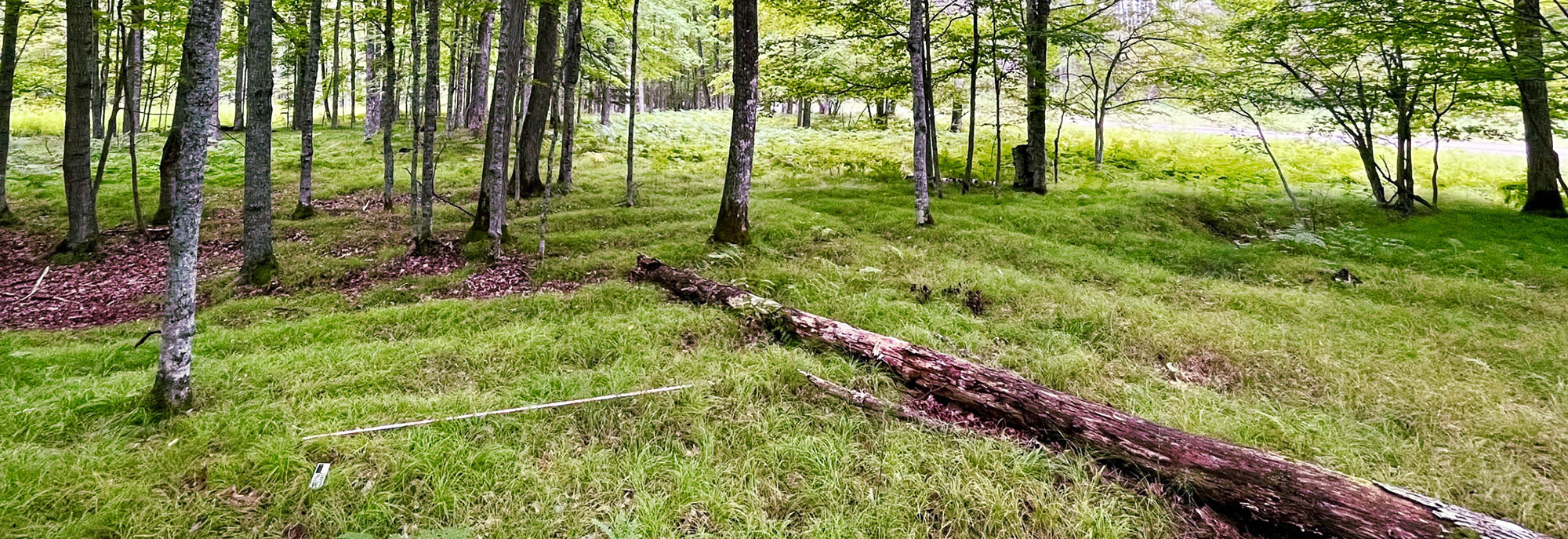
Archaeological site investigating ancestral Menominee agriculture in northern Michigan.
Madeleine McLeester image.

A few days ago, via Connecticut Public Radio, I learned of recent archaeological research finding evidence of large-scale precolonial Indigenous agriculture in northern Michigan. The research findings, published recently in Science, discuss an ancestral Menominee agricultural site consisting of at least 95 hectares of raised, ridged fields planted mainly in maize, beans and squash maintained, likely for centuries, between about 1000 CE and 1600 CE. The study authors report further evidence, in the form of burial mounds, ritual earthworks and village sites, indicating that the fields were intricately connected to the broader Menominee cultural landscape.

These research findings are important for a variety of reasons. First, the Menominee fields (only partially surveyed to date) may be the largest surviving precolonial Indigenous agricultural site in eastern North America–a crucial find given (a) that pre-contact Indigenous communities were long believed to have maintained settlement sites only for short periods, and (b) that more than 90% of pre-contact Indigenous landscapes have been obliterated from the landscape by settler-era farming and development over the last 400 years. Second, their scale, sophistication and long duration underscore the reality that pre-contact Indigenous cultures modified landscapes in extensive and prolonged ways—via deforestation as well as through extensive earthworks and the movement of soils (e.g., floodplain soils brought to the fields, and evidence of compost used as soil amendments)—to serve agricultural and cultural aims. Third, the cultivation of maize on a large scale near the northern extent of its range invites a reexamination of historical crop practices and precolonial population distributions.

I love these research findings because, in the way that innovative research often does, they deftly upend received notions—in this case, about Indigenous impacts on the land. Far from flitting through the woods, leaving few traces (as “empty continent” claimants still insist) —or, alternately, living in Edenic harmony with nature—Indigenous North Americans were active agents of environmental change and extensive modifiers of landscapes. The archaeological evidence, bolstering Menominee narratives, indicates a long history of sophisticated cultural practices, specialised resource activities, and extensive trade networks.

It is also worth noting that the extensive patchwork of linear mounds also rebuts a ridiculous but often repeated claim that Indigenous structures (& epistemologies) were all curved, in contrast to colonists’ supposedly straight lines. I note this because more intelligent framing of the differences — and similarities — between Indigenous and settler ways of knowing & doing are needed both to add to cultural understanding and to advance projects of reconciliation, not to mention appreciating the complexity of North American landscape history.

I also love these research findings because, for the first time in longer than I can recall, they make me excited about contemporary scholarship. In the last three decades the so-called cultural turn has brought important insights to the social sciences and humanities—but it has also, in recent years, led them to become increasingly pedantic, orthodox, and ossified. Increasingly often, evidence is harnessed to serve a foreordained premise about what (and who) is ‘good’ or ‘bad,’ determined along ideological lines. In this rubric, far too much scholarship has, contradictorily in this supposed age of interdisciplinarity, become doctrinaire.

To me, good scholarship should open up subjects to further investigation, not close off questions. By challenging received notions about how pre-contact Indigenous communities used the land, McLeester et al make room for further exploration of Indigenous land uses, economies and cultural practices. Two areas of follow-up relevant to this particular research program include learning more about the reportedly non- or less-hierarchical nature of ancestral Menominee communities, their trade networks, and village sites (strongly implied, it seems to me, by the use of domestic compost in the fields) the teams have yet to uncover. That the team will likely continue to combine field archaeology methods with oral histories from contemporary Menominee knowledge-keepers makes this a project to keep watching.

What Remains Read More »

Seen: Albino Milkweed

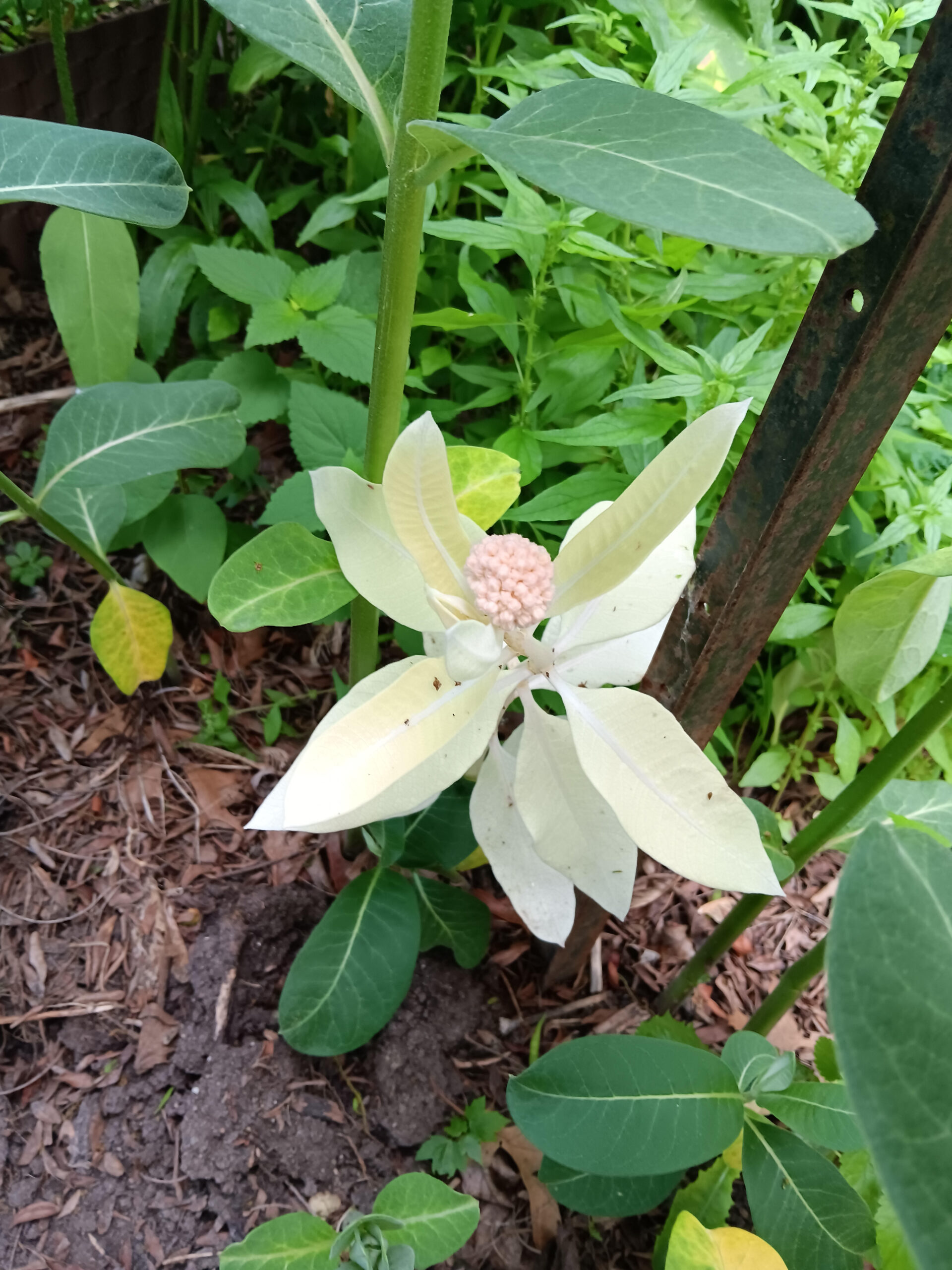
albino milkweed

Yesterday, while tending to the pollinator garden I coordinate in a nearby public park, I was surprised to see this common milkweed (Asclepias syriaca) exhibiting albinism.

Apparently albino milkweeds occur infrequently in nature, likely due to a genetic mutation. Because they lack chlorophyll, they are unable to photosynthesize and, reportedly, do not live as long or grow as large as ordinary milkweeds. However, milkweeds spread by rhizome, meaning that albino milkweeds may gain nutrients from fellow plants to whom they are connected.

Albinism in plants is never common, but reportedly occurs often enough in redwood trees and orchid plants to suggest it may confer some evolutionary advantage (perhaps especially in shade and understory environments), wherein non-chlorophyll-producing plants—known as mycoheterotrophs—forgo photosynthesis in favour of parasitizing mycorrhizal fungi. One wildflower native to Canada, Monotropa uniflora or ghost pipe, is fully mycoheterotrophic.

[Personally, I object to the term “parasite” to describe mycoheterotrophic plants. If the mycoheterotroph gains or borrows energy without harming the source plant or fungal organism, it seems to me it would more properly be described as a commensal.]

I cannot say whether the albino milkweed in my local park has ‘chosen’ a mycoheterotrophic strategy or is simply a mutant plant. It is noticeably smaller than its peers, but seems healthy so far and shows the beginnings of a blousy blossom head. I will monitor it through the season to see how it grows. I’m curious to see whether it will remain healthy and, equally, whether its blossoms will attract insects.

In the meantime, my mutant milkweed is a thing of beauty and a source of wonder, nestled in among her green sisters. I am grateful to her for existing, and for giving me the opportunity to learn something new about plant genetics and physiology.

Seen: Albino Milkweed Read More »

Shelter

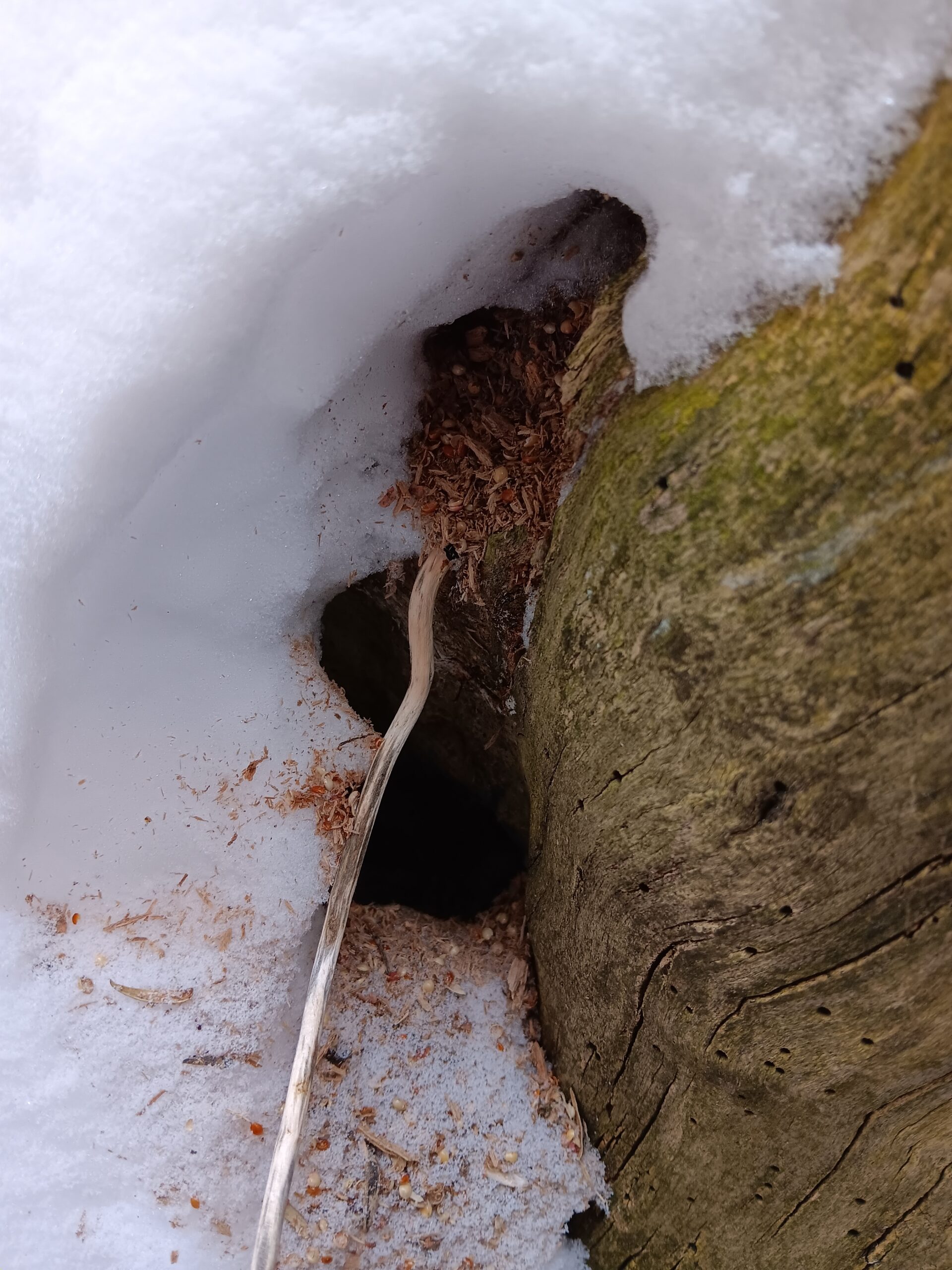
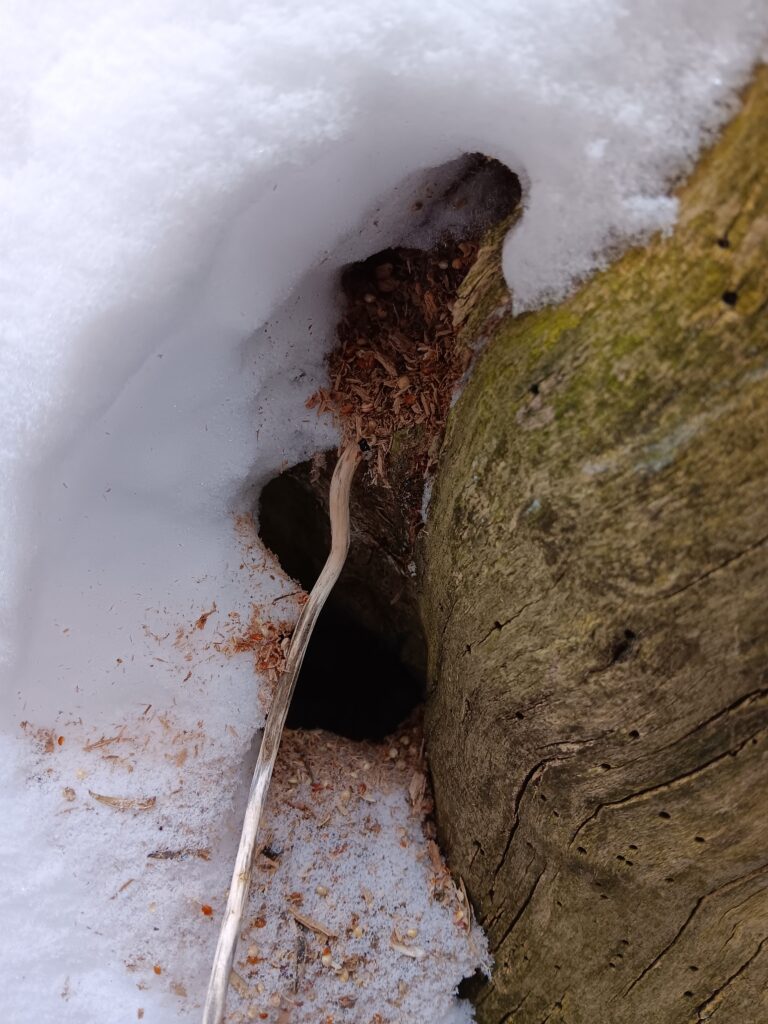
Image shows a small burrow entrance through snow into a dead tree stumpManitoba maples (Acer negundo) are native to northwestern Ontario and the prairie provinces, but have controversial status in southern Ontario, where they can spread aggressively. Manitoba maples grow quickly, colonizing disturbed areas such as vacant lots and along urban alleyways. Due in part to rapid growth, Manitoba maples tend to have brittle branches, leading to their reputation as ‘junk trees.’

But Manitoba maples also provide useful ecosystem services. They reduce erosion, hold soil, and grow where many other trees struggle to take root—especially important in disturbed areas. Their seeds feed squirrels and (among other birds) attract the evening grosbeak, a member of the finch family with distinctive yellow plumage. Manitoba maples also host boxelder beetles and rosy maple moth.

I am ambivalent about Manitoba maples. For years we had several growing on the margins of our city property. One, out front, we maintained as a privacy hedge until, tired of the need to prune it twice every summer (Manitoba maple branches grow as much as 2 metres each year, with pliable green shoots turning woody and dense by the following growing season), I cut it down. Fortunately an eastern redbud had volunteered beneath it— a slow-growing native species which produces a dreamlike halo of violet blooms early in the spring.

In the back, between our and our neighbours’ garages, a Manitoba maple once quickly grew tall and thick enough to crack the pavement in the walkway and damage the eavestroughs on both structures. With regret we took that tree down—except for an eight foot stump my husband suggested we leave in place to serve as a post supporting our back gate.

Over the past decade that stump, now weathered to bare wood, has housed a surprising variety of creatures. For several years a colony of carpenter ants dwelt within its chambers, hollowing out the wood until the stump resonated like a drum when rapped. One year, after the ants had moved on, it housed a small colony of native bumblebees. The stump has also housed a variety of shelf fungus, including turkey tail and Dryad’s saddle, and from time to time raspberry canes have sprouted from openings in its trunk.

Each year the stump wobbles a bit more on its axis, as what remains of its roots decay and gravity calls it back to earth. Last summer my husband stabilized the top with wood and wire, hoping to buy another two or three years out of our organic gate post. Our plan, when the trunk finally falls, is to take it to the circle park just down the street, where I coordinate a community pollinator garden, to enrich the soil and provide valuable habitat as it returns to earth.

Over the last few days Toronto has received a major dumping of snow, with about 50 cm accumulated over a three-day period. Between snowfalls we’ve managed to keep the sidewalks and walkways clear, albeit with snow mounded high on either side. While clearing snow near the back gate some of it, inevitably, ended up piled against our Manitoba maple stump.

This morning, on the way out back to shovel out the car, I noticed several small openings in the snow right against the trunk. Burrow holes, for a mouse, or a chipmunk, or possibly even a rat. Alongside them was a small cascade of wood shavings, sawdust from burrowing, Somebody, it seems, is overwintering in the long-dead stump of our Manitoba maple, taking shelter against the storm.

The next time I go out, I will leave it a small offering.
Shelter Read More »

The Changing of the Clocks

swamp milkweed

Unusually this year, although I had made a note in the calendar, I forgot that the clocks ‘fell back’ an hour overnight. It was about 10:30—er, 9:30—before I looked at a digital clock this morning and realized our daughter, whom we’d hounded out of bed already exhausted from the first day of her Bronze Medallion qualification course, still had an extra hour to get ready for swim.

The extra hour is illusory, of course: a reminder that there is always a cost to playing with Chronos. An extra hour on a November morning is lovely, but by mid-afternoon one looks up at the clock, thinking it must be getting on to dinnertime, maybe even bedtime, and is dismayed to see how many more miles hours there are left to go before sleep.

As I write this it is 5:15 pm, and outside it is at the tail end of twilight—as close to dark as it might be at 9:30 pm at midsummer—and this makes me feel as if rather than gaining an hour with the changing of the clocks, we’ve actually lost about four.

These lost hours are what propel us toward hibernation, or at least carbohydrates and cozy mysteries. We turn inward, measuring the hours by midnight snowfalls and mugs of cocoa, and remain that way until New Years’ resolutions and the blinding January sunlight drive us out of our dens.

With the coming winter in mind, I went out today and, in the bleary November sunlight, put the gardens at the circle park to bed. Yesterday my excellent neighbour and I planted about 100 bulbs as a springtime surprise to our community, and today I mulched the beds with fallen leaves, swept the walks, and communed with the native plants tucking themselves in for winter.

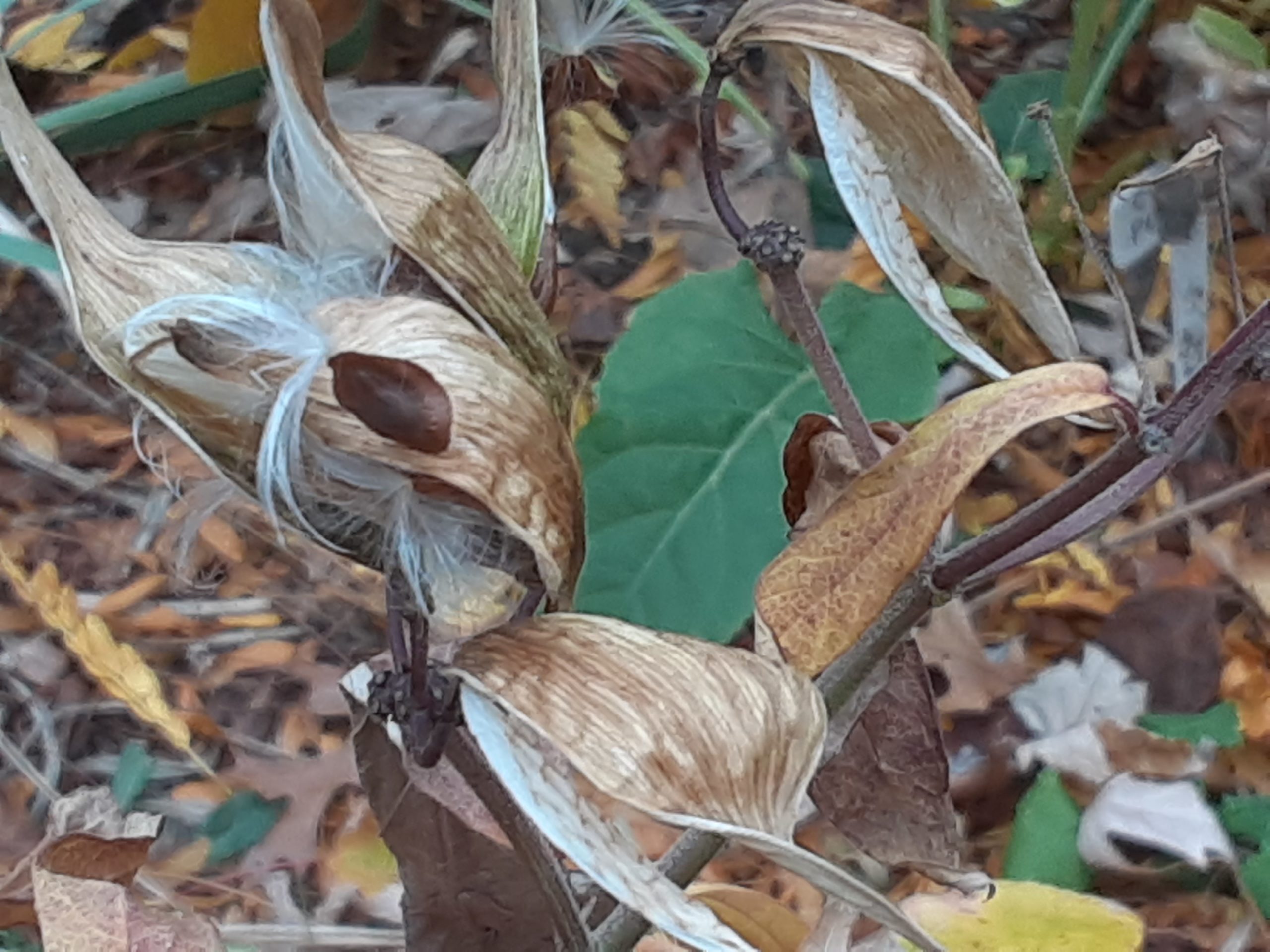
Swamp milkweed pods
habitat logs

I am so pleased with what we accomplished this year at the circle park. In April the park was barren, much of its soil compressed into hardpan. In a single growing season we have transformed much of it into a living green space, replete with native flowering plants buzzing with insects. But I think the real measure of the park’s progress has been its late-season appearance–seed-heads bursting with promise, habitat logs settling into the soil, fallen leaves laid down like a blanket. It looks like a healthy woodland, a place possessed of its own sense of time, whose rhythms are closer akin to Kairos rather than to any arbitrary changing of the clocks.

The Changing of the Clocks Read More »

Turning

exquisite milkweed pod

This morning a sense of turning. The sunlight slightly muted, the clouds luminous but shadowed underneath. A cool undercurrent on the breeze. Two days ago robins massed in the cedars, and today they have gone. Birdcast (a wonderful resource powered in part by the Cornell Lab of Ornithology) reports a peak of bird migration is expected tonight, with 337 million birds expected to cross the night sky, navigating by the signals (cues in the quality of light, currents in the air and soil) that send them south.

Those of us who are earthbound prepare in our own way. I gather my preserving equipment and assess the ripening crabapples. It is time to pick sumac. On some bright, breezy day next week I will harvest my herbs and hang them to dry. In the coming weeks it will be time to make preserves.

I need to stain the front porch, and do some tuck-pointing of the bricks.

squash plant losing its gourdOne of my major projects this year has been establishing a natural garden at the circle park down the street. This work has been supported by the efforts of many community members as well as the City of Toronto, which provided us with a starter set of native plants. The park, long a desolate and derelict space, has been transformed into a living landscape of native plants and shrubs that has hosted many native species of bees, butterflies and other insets. Early in the summer I brought over all my not-quite-finished compost, figuring it would continue to break down in the soil, adding much-needed nutrients to support the new plants. As a bonus, a surprising number of garden plants have self-seeded, including tomatoes, dill, and several kinds of vines. This morning the melons and squash look ready for harvest; the pumpkin, still green, is nearly the size of a soccer ball; and the tomatoes (possibly Black Krims or, more likely, Green Zebra) are developing their distinctive stripes.

Soon, though, the garden will start to go dormant, and I am looking forward to ensuring it has a good cover of mulch to protect tender roots throughout the winter. But until then the asters, just beginning to flower, will bloom all wild and wooly, feeding wasps and bees right up until frost.

flowering aster with bumblebee

Turning Read More »