Nature

Natural History in Print | Tenants of An Old Farm (1886)

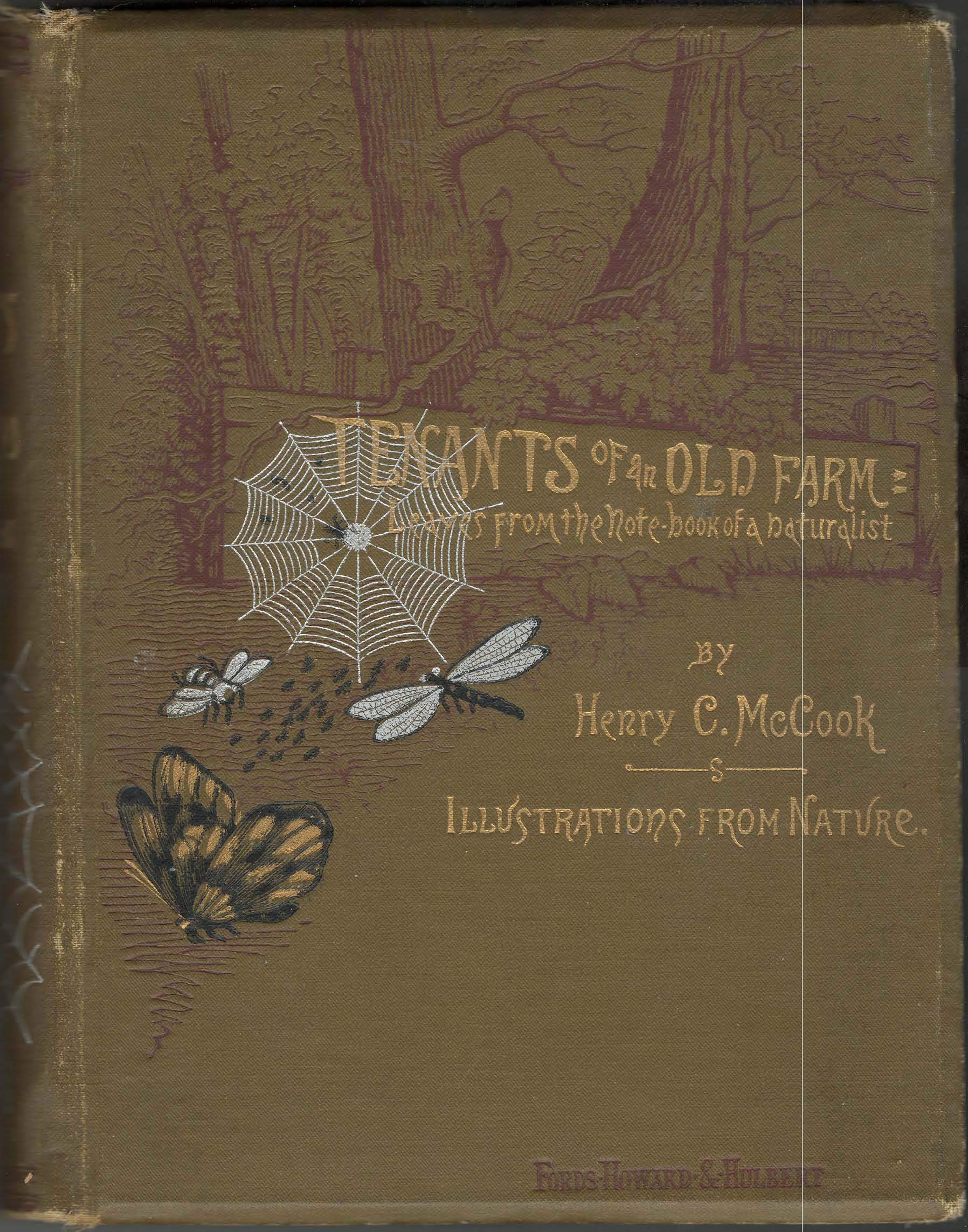
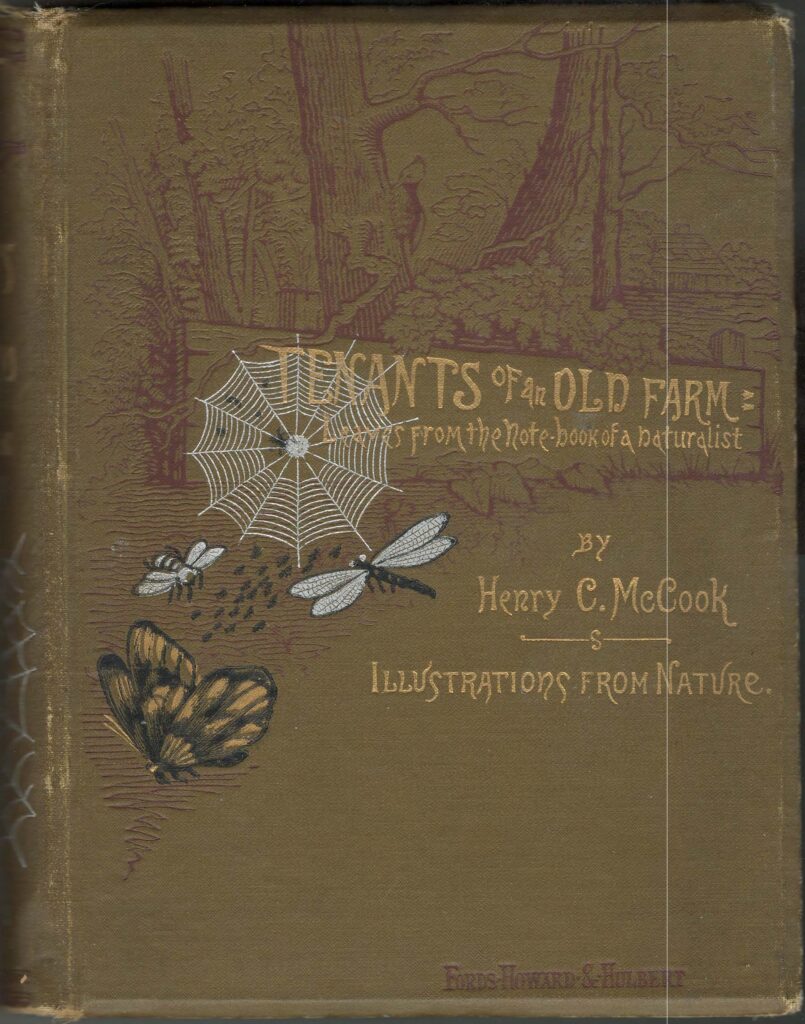
Cover of an old book titled Tenants of Old Farms. Text is gilt; illustration shows spider web and insects. 1886. I am very fond of old natural history books, particularly those published prior to about 1910. They are usually charmingly written, often perspicacious in their discussions of science, and almost always beautifully printed and illustrated.

Tenants of an Old Farm: Leaves from the Note-book of a Naturalist (which I bought for $20 at last year’s Trinity College Book Sale) is a splendid example of this type of book. Originally published in 1884 (my copy the Third Edition of 1886), it was written by Henry C. McCook (1837-1911), a noted American naturalist and (Presbyterian) clergyman. McCook was, among many other things, an expert on ants and spiders. He published eight books on insects and nearly a dozen on theology—a particularly interesting confluence in the wake of Charles Darwin’s work on natural selection.

And indeed, evolution—and Darwin himself—are referenced in Tenants of an Old Farm. In a chapter on burrowing insects, the narrator (McCook himself, the reader presumes) probes into a farm visitor’s views on evolution , hoping to spur an argument:

“Perhaps, I suggested, thinking to draw the Doctor’s theological fire, “The insect is a far-away ancestor of the vertebrate? At least, an evolutionist might have no difficulty in accounting for such resemblances by some application of this theory.”

The Doctor surprises the narrator by supporting the proposition:

The Doctor glanced slily at me, smiled, and answered: “Ah! you shall not disturb my equanimity so. Evolution is no theological bête noir to me. Not that I believe it all; on the contrary, I think it is yet an unproved hypothesis. But, considered as a method of creation simply, I am willing to leave it wholly in the hands of the naturalists and philosophers. Of course, that materialistic view of evolution, which dispenses with a Divine Creator as the First Cause of all things, has no place in my thought. That is not for a moment to be tolerated; but, as for the rest, why should Christian people disturb themselves? Science has not yet said her last word, by any means, and we can well afford to wait.”

In this way, McCook introduces and quells the theological argument against evolution while deftly modeling the method of science: weighing theories in light of the available evidence and remaining open to new explanations.

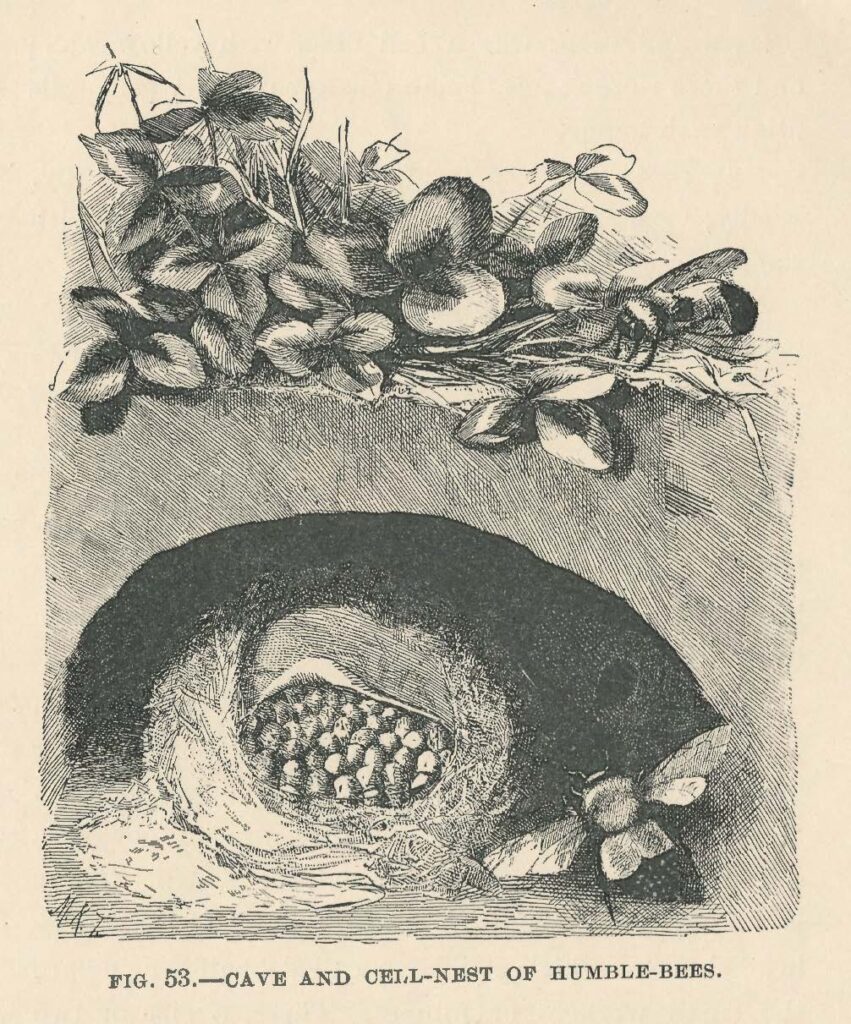
Later, in a chapter titled ‘The History of a Bumble-Bee,’ the narrator directly references “the late Mr. Darwin [and] his book on the “Origin of Species” in a discussion of co-evolved relationships among living things:

We may infer, he says, as highly probable, that were the entire genus of bumble-bees to become extinct or very rare in England, the heart’s-ease and red clover (which they fertilize by carrying pollen from flower to flower), would become very rare or wholly disappear.

Given that some religious leaders remained hostile to the emerging science, viewing it as a threat to Biblical teachings, McCook’s handling of the subject comes across as nuanced and refreshingly balanced. Would that such differences could be handled nearly as deftly in this ideological age!

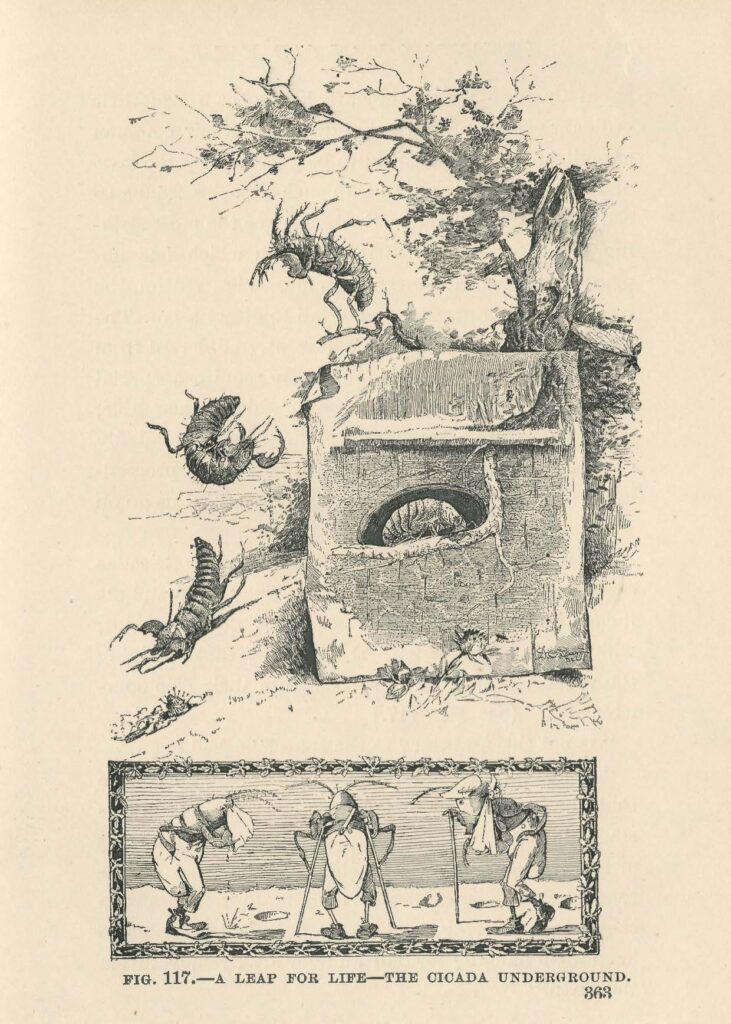
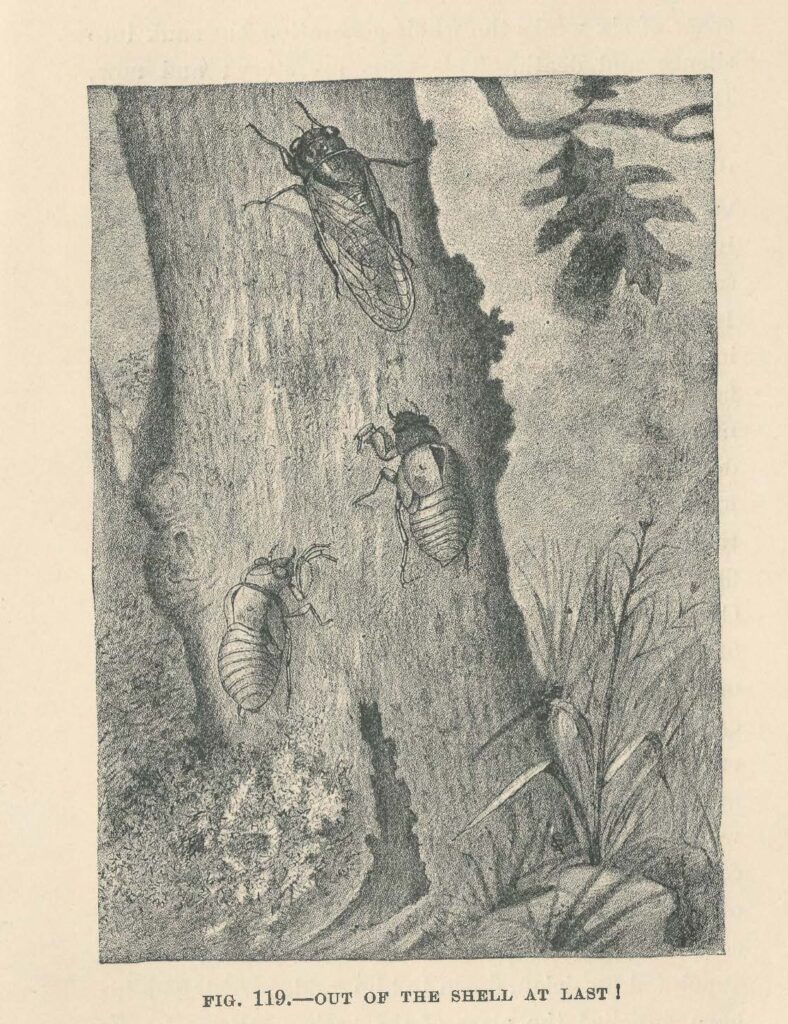
The book’s illustrations are detailed and often amusing. Look at these images showing the life-cycle of the cicada:

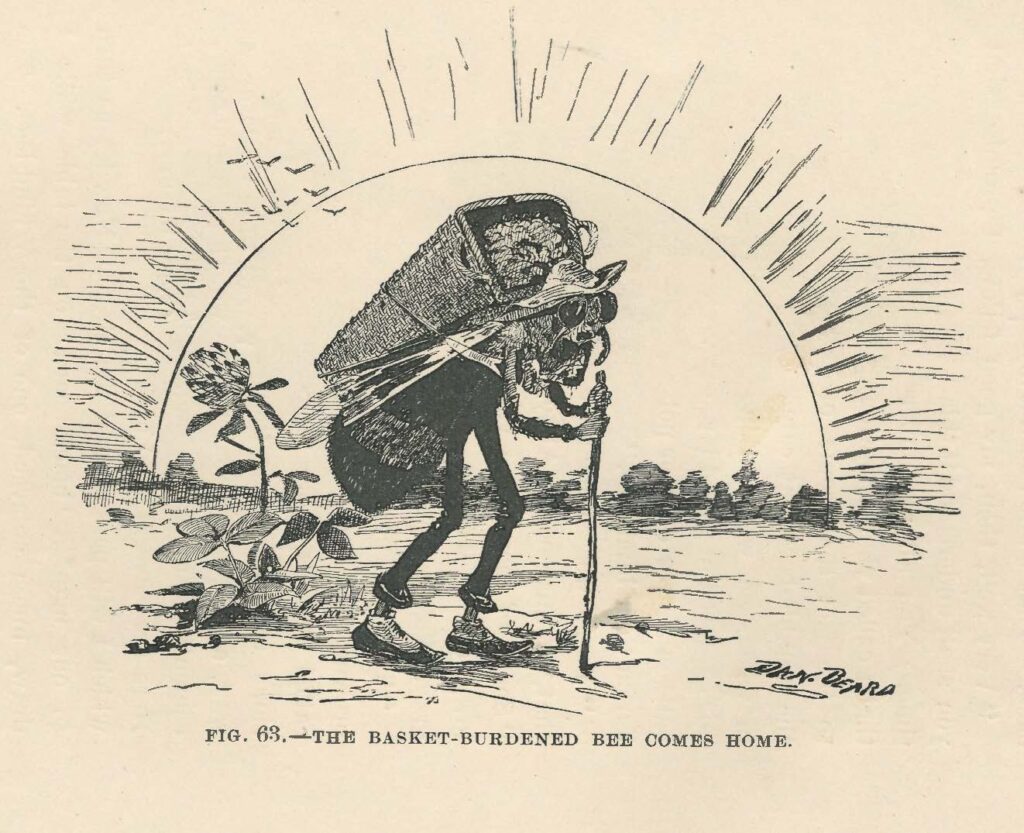
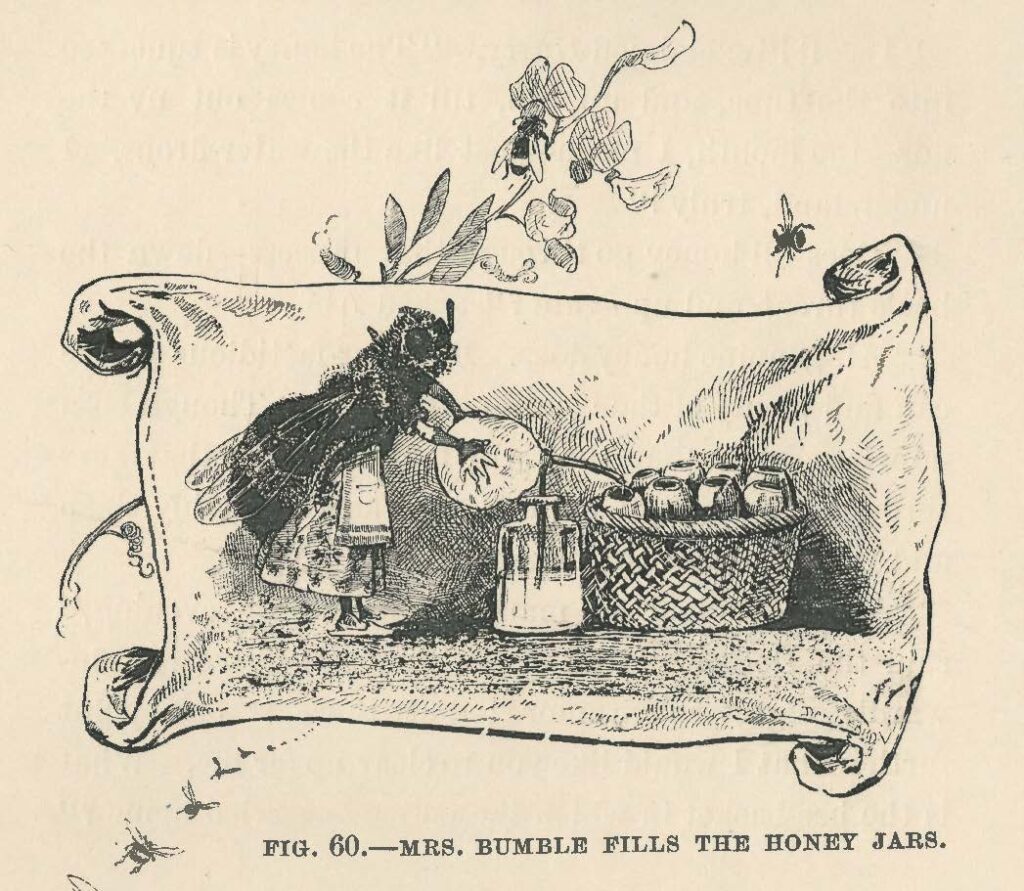
… and these highly anthropomorphic images of the hard-working bumblebee:

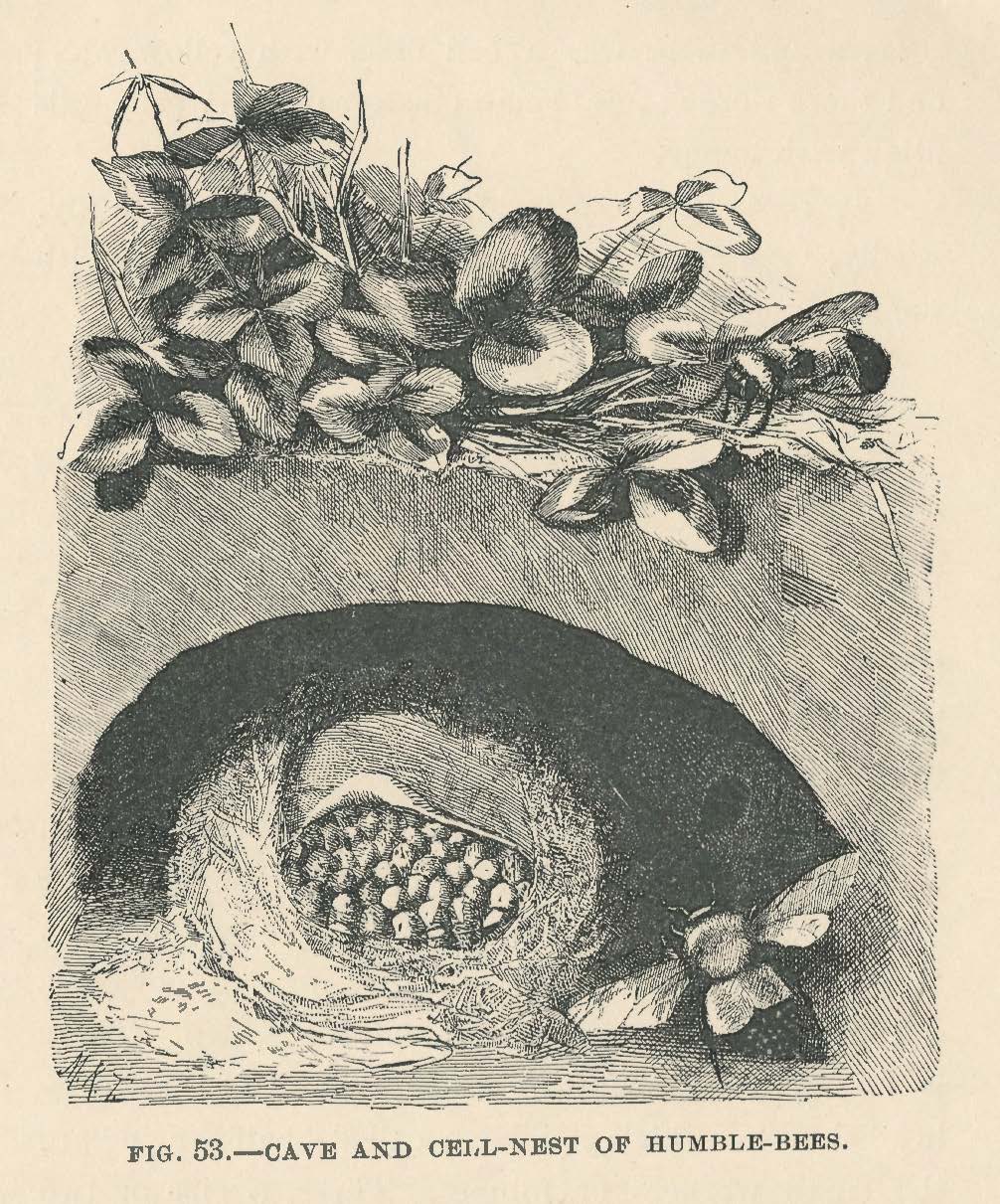
… plus this cross-section of ground-dwelling bumblebee nests:
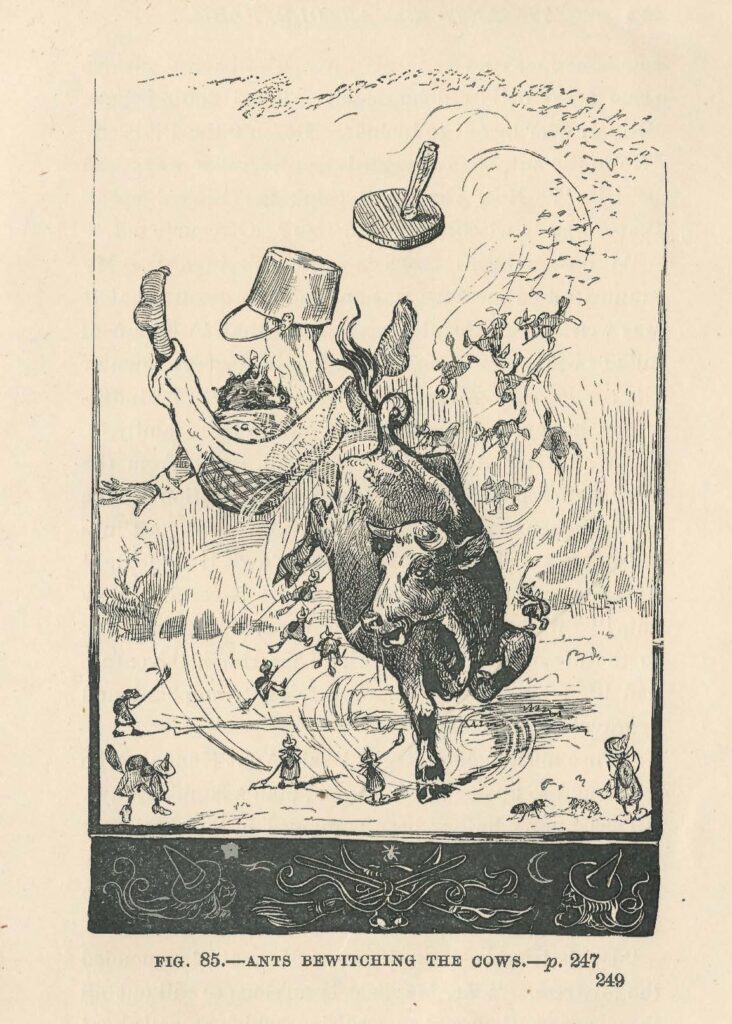
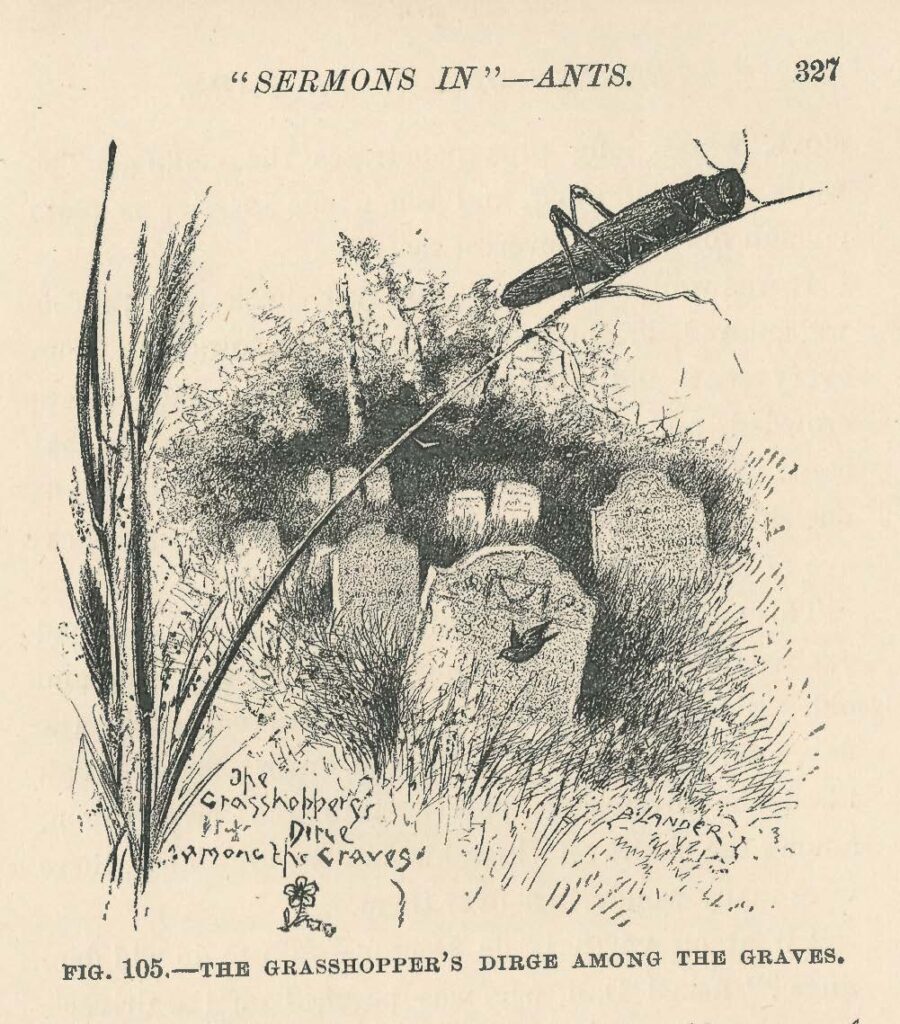
… and, finally, these two somewhat perplexing images (which make perfect sense in narrative context) of “Ants Bewitching the Cows” and “The Grasshopper’s Dirge Among the Graves:”

If you are interested in McCook’s work, the Biodiversity Heritage Library has several of his books and articles available in digital format. Tenants of an Old Farm is also available at the Internet Archive.

Natural History in Print | Tenants of An Old Farm (1886) Read More »

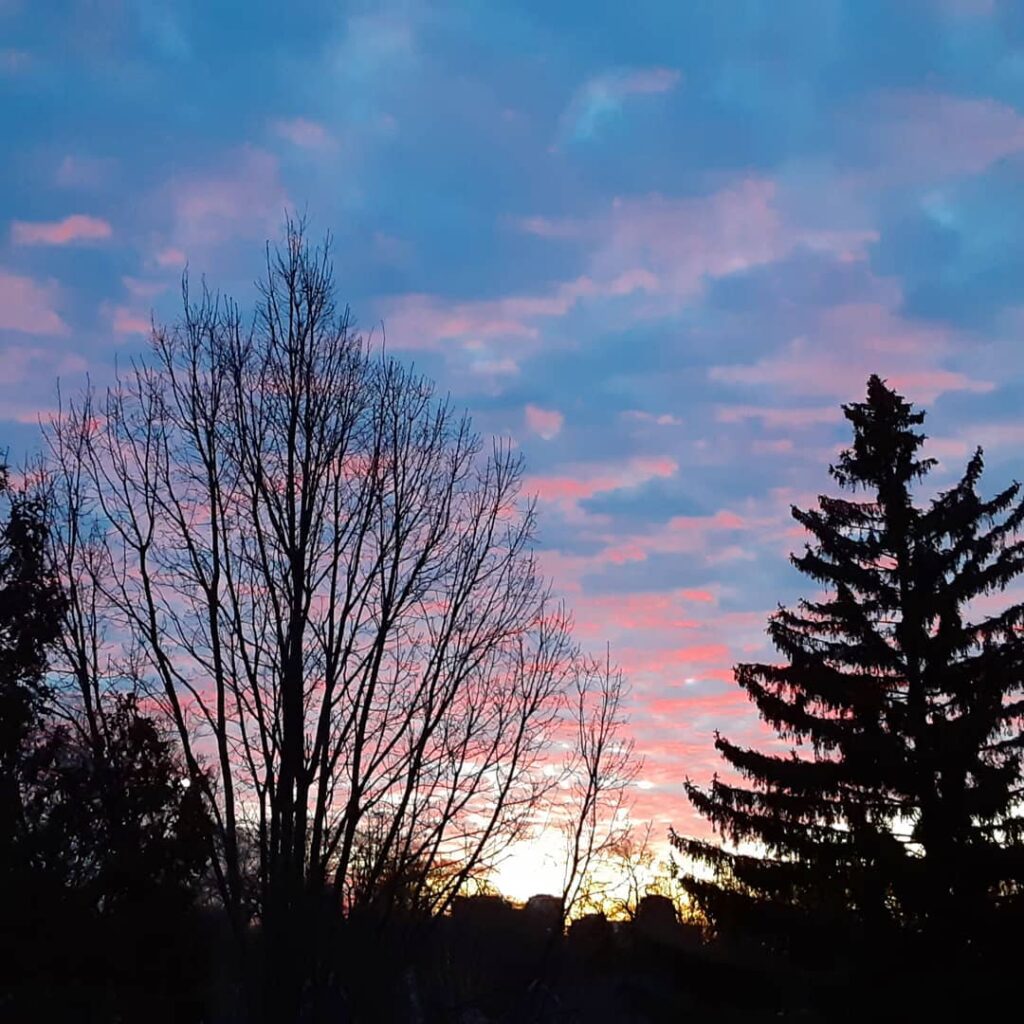
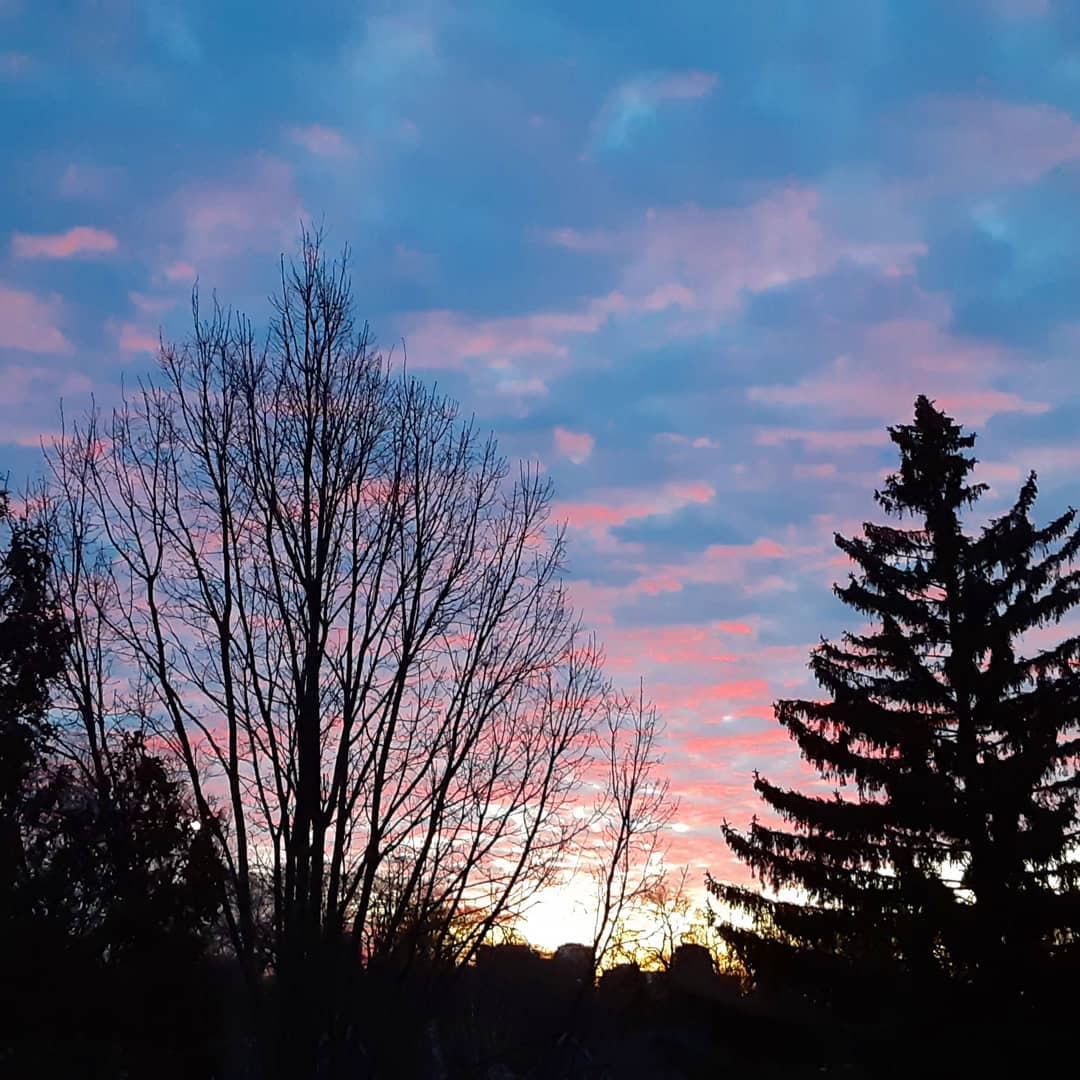
winter sunrise, showing hues of blue and pink silhouetting bare oak and a tall spruce or fir

Winter Sunrise

winter sunrise, showing hues of blue and pink silhouetting bare oak and a tall spruce or firSix years ago, on the second day of the year, I took this picture from the rooftop deck of our home in the west end of Toronto. I like the way it captures the slow return of light to the hemisphere, silhouetting stark wintry forms in the middle distance.

Light returns: already the days are seven minutes longer than they were at the Solstice, with precious extra minutes of daylight currently noticeable mainly at dusk. Soon the sun will rise noticeably earlier, and when it does, around the end of January, the buds on the silver maples will grow fat and the crows will again begin to call.

Light also returns at night. The full Wolf Moon—a Supermoon this month—rides high overhead (at its fullest this morning at 5:03 am EST), and if the weather is clear this will be the best evening to view it, rising in the east right at dusk. In Toronto, the best place to view the full Wolf Moon is in a car traveling east toward downtown along the lakeshore, early in the evening. There is uncanny beauty in the city skyline laid out beneath the huge glowing moon. If the conditions on the water are right, moonlight illuminates the lake like a painting.

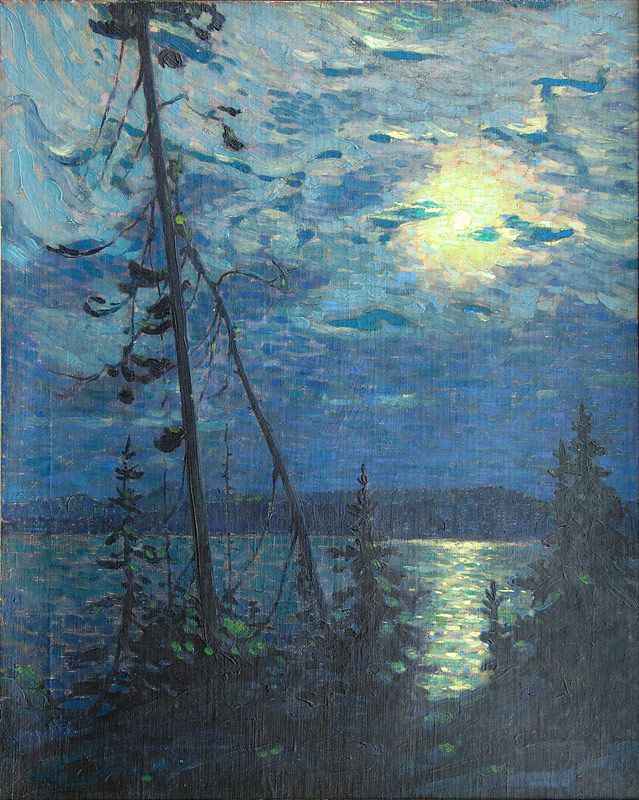
I have no good photos to share of the full moon over Toronto, so here is Tom Thomson’s luminous painting ‘Moonlight’ (1915-16).

Tom Thomson painting, Moonlight, Winter 1915-16, showing a nighttime scene of moonlight over a lake with trees in the foreground
Tom Thomson, Moonlight, 1915-16.

Winter Sunrise Read More »

A Red Bird in Winter

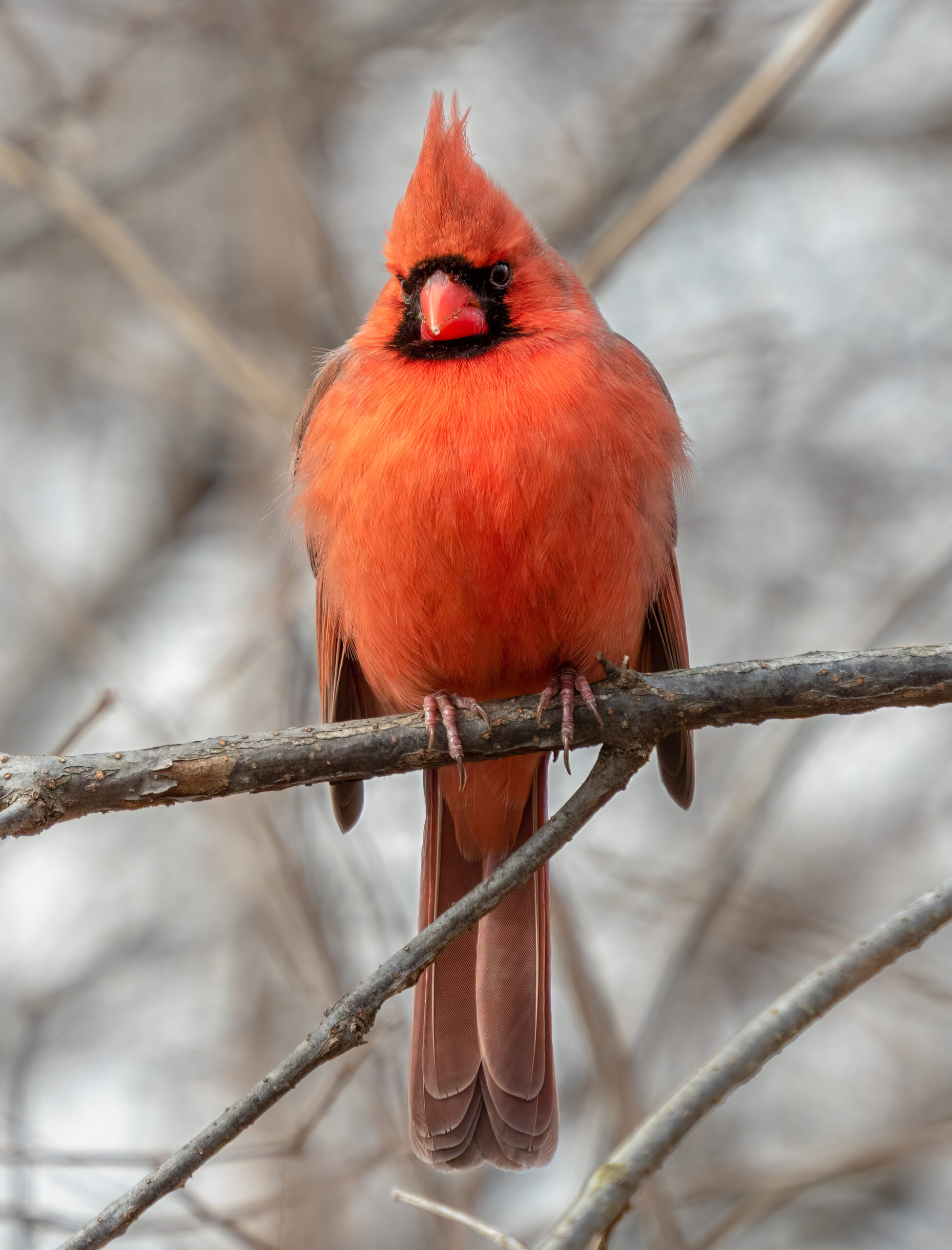
northern cardinal
Northern cardinal. Image source. Creative Commons license.

During the long night of winter the city pauses, midway between dark and day. It goes on like this for weeks: each bleary dawn, the fickle light, the slow descent into twilight. There are consolations, however. A morning sky like burnished silver; the sly moon, gliding across the landscape. After a snow the light is brilliant, and on the first day of the year we dredge for hope in its drifts.

All the things we might love appear without warning, appear out of nowhere, like the red bird in winter that turns the season toward light. The winter swells like a wound; it wells up in us; suspends us, our shovels frozen in mid-air. We are like mammoths, fossils imprisoned in ice until something in us trickles free, until the crystalline structure shatters and we move again, flowing toward the light.

On the first day of the year the houses across the alley loom like old ghosts. They waver in a squall, their shape traced and erased by branches. A cardinal lands in the cedar, sings despite the storm. A light goes on in someone’s kitchen, a kettle scrapes across the stove. And rapidly I dress and put on my coat, and go out to greet the year.

[A version of this post appeared at Reading Toronto on 1 January 2008.]

A Red Bird in Winter Read More »

In Season: Mulberries

A tub of mulberries, freshly picked.First pick of mulberries today. The street trees we usually pick from have had all their lower branches pruned in a hopeless (I dare not say “fruitless”) effort to reduce the masses of mulberry fruit squished into jam on local sidewalks, but about a kilometre away I found a street tree laden with low-hanging fruit and, with the property owner’s permission, picked about 4 cups.

Mulberries have a sweet and slightly tart taste. They make excellent mulberry-lavender ice cream, very good jam, and are an unbeatable companion to dark chocolate. They also stain strongly, and would likely make excellent purple or burgundy dye or ink. Like most berries, they freeze easily for use throughout the year—a good thing, because mulberries in the Toronto region fruit briefly, a week or two before the raspberries are in full swing, from late June to mid-July. The best mulberries to pick are the fat, long ones that detach readily from the branch. Mulberry trees with eastern exposure seem to produce the sweetest, fattest berries.

Mulberry trees are somewhat controversial in native plant circles, mainly because Asian white mulberry trees (Morus alba), reportedly introduced to North America in the 1600s, have replaced or hybridized with native red mulberry (Morus rubra) and are therefore considered invasive. Native red mulberry is severely endangered in Ontario: reports from 2014 indicated that there were only 217 red mulberry trees remaining in the province, clustered mainly in southwestern Ontario.

Personally, I am on the fence about hybridized mulberries. I am always open to correction, but currently it is my non-expert impression that the proverbial ship may have sailed on the prospect of restoring a sustainable population of non-hybridized red mulberries in Ontario. I am not convinced it is possible or even desirable at this point to eliminate hybrid trees. Having said that, at least two native red mulberry trees are on my wish list for Maher Circle and, if we are able to procure some for our native pollinator garden, I will endeavour to maintain a 50 metre clearance between our natives and any non-native or hybridized mulberries.

In the meantime, however, I am happy mulberry season has begun, and hope over the next week to pick a year’s worth for the freezer, of which a quantity will go into a batch or two of delicious mulberry-lavender ice cream.

In Season: Mulberries Read More »

Seen: Producers of Miracles

Wild bumblebee pollinating raspberry blossoms on 1 July 2025, Toronto, Canada.Today is the third of July, and my raspberries are producing fruit. The first ripe berries, hot in the sun, always, are reverently consumed: sweetness on the tongue. Afterward, most of the berries go straight into the freezer until I have enough to make milkshakes, ice cream, and jam.

Reverently, too, we observe the bumblebees who pollinate the flowers and are therefore the raspberries’ principal keepers. Here is one, hard at work a few days ago, a producer of miracles in summer sunlight.

*

The cicadas are in season, too. I heard the first one of the season late yesterday, as the humid evening eased itself into dusk. I heard it again this morning, and hopefully soon we will have a loud chorus of cicadas, droning in the summer air.

*

Also, seen recently in my woodland garden: a male blackburnian warbler! I am terrible at bird identification, and my phone camera managed only pixelated pictures, but blackburnians have such distinctive plumage that it was fairly easy to narrow down the species while flipping frantically through my collection of field guides. I assume this bird was in transit and stopped by my woodland garden to shelter under the cedars and enjoy the bird bath.

Seen: Producers of Miracles Read More »