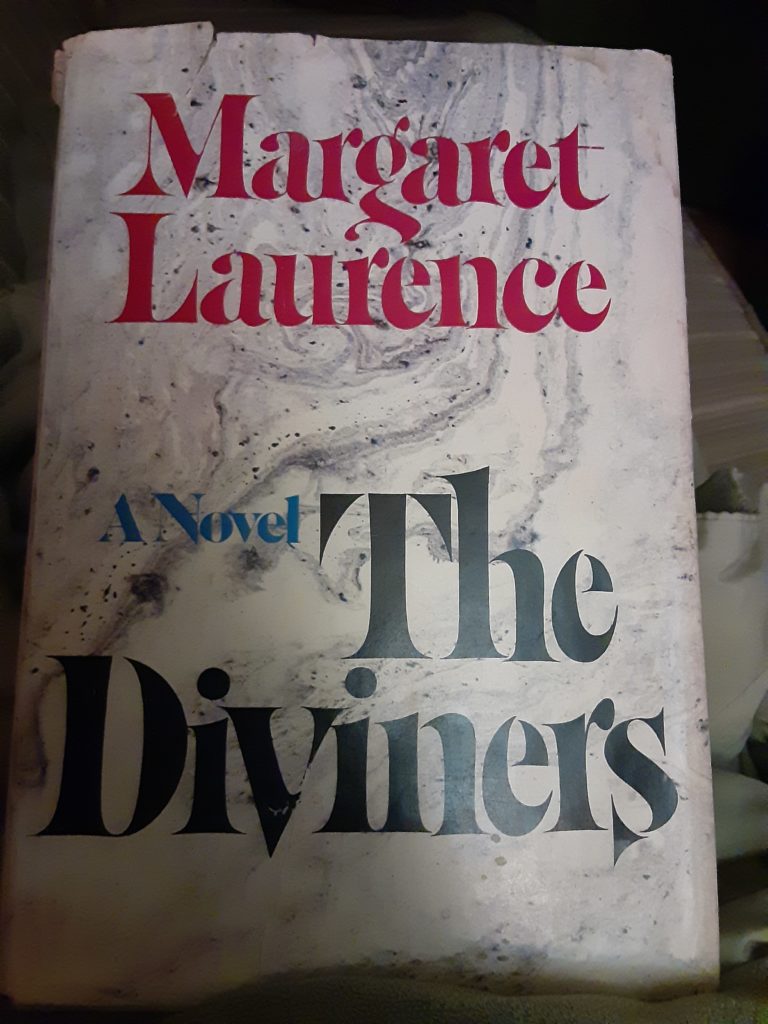
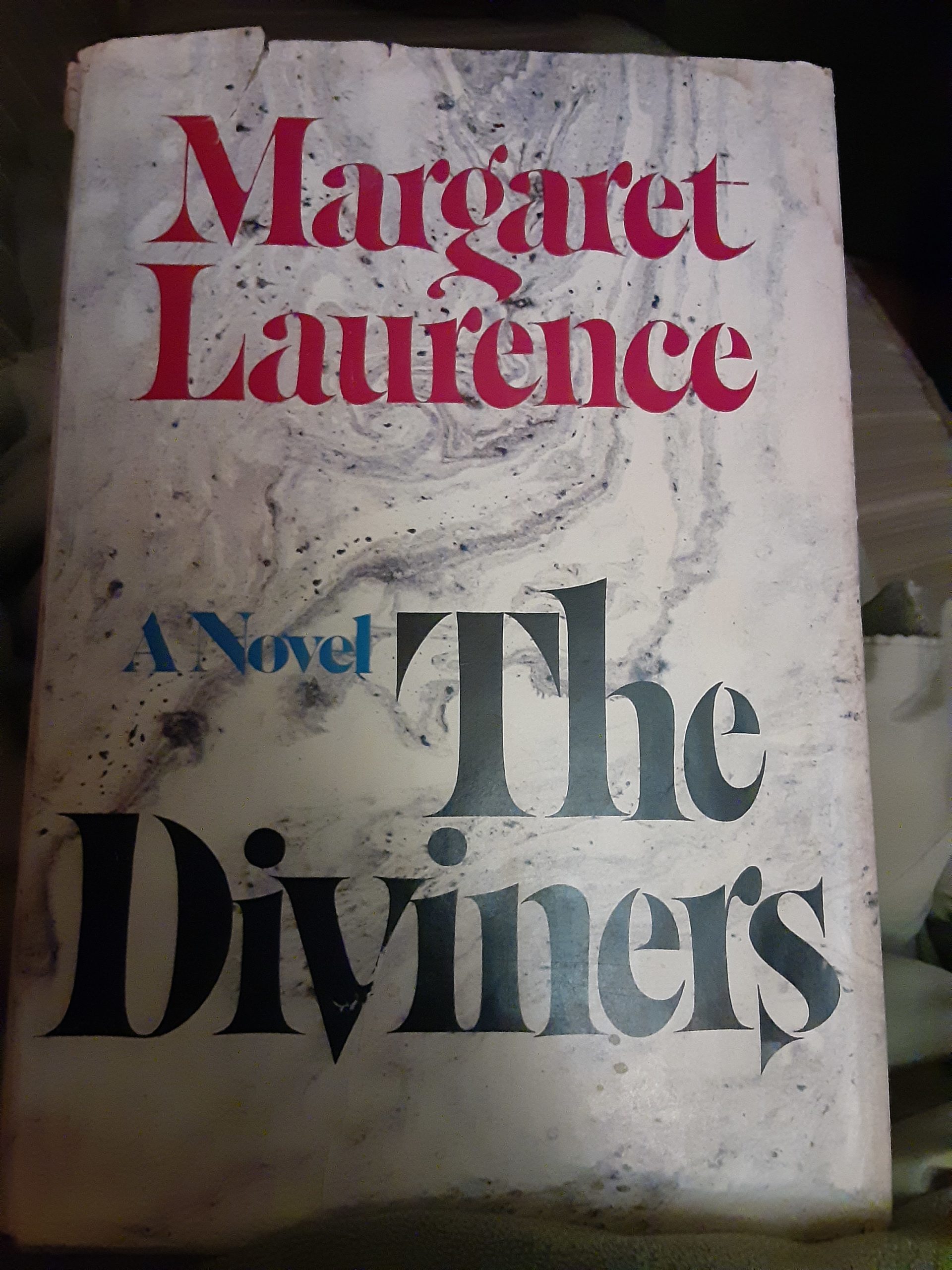
First edition hardcover copy of Canadian writer Margaret Laurence's 1974 novel The Diviners.

Currently Reading: The Diviners, by Margaret Laurence (1974)

[Note: as social media as we’ve known it goes through its prolonged and probably overdue death throes — Cory Doctorow aptly calls this the inevitable result of the ‘enshittification‘ of online platforms — I’m trying out posting things here I might ordinarily have consigned to social media, including provisional and fully-formed thoughts, reviews, recommendations, image galleries and editorialized links. The decline of the relatively open internet ‘out here’ is a real problem, compounded by secretive and coercive algorithms, ossified social networks, the active throttling of news and information, and the manifest decline of social discourse. One of the things I miss most about the open internet (that is, online environments accessible to anyone online, not closed within subscription-based social media platforms designed to hold users hostage to their social networks and keep them scrolling and clicking material they didn’t choose and may not even want to see) is the joy of discovery and the opportunity to pause over something — a ‘long read’ essay, an arresting set of images — and actually think. As a researcher I have a deep love for discovery, but it’s increasingly hard to remember a time when I regularly learned new things or had my mind changed on social media — other than developing an increasingly clear conviction that the social media platforms where many of us interact ‘in public’ have become bad places — and here I am reminded of the excellent work of moral geographer Robert Sack, about whom I will write more soon — that do real harm to their users and to public discourse more generally.]

When I was in high school, Margaret Laurence was required reading in upper-year English classes, usually alternating between The Stone Angel (1964) and The Diviners (19974). Oddly enough, I am not sure either book was assigned reading in any of the classes I took, although I did read The Stone Angel (and the linked stories in A Bird in the House, 1970) and thought for many years that I’d also read The Diviners. It turns out I had not, although I would have preferred it vastly to Susanna Moodie’s tedious, complaint-filled memoir Roughing it in the Bush.
The other night, while casting about for something to read on my shelves of Canadian literature, The Diviners practically leapt into my hands. I have meant to dig into Laurence for a while, but have so little time for purely leisure reading that I’ve put it off. I settled in with the book, and very soon felt a poignant sort of sorrow that I hadn’t read this book when I was still young enough to get completely lost in Laurence’s story (and oh, wow: it would have been an excellent accompaniment to the months I spent binge-reading Alice Munro in my early twenties). The Diviners is written in Laurence’s inimitable voice, which is plain-spoken (even crude, some would say) and irascible. A characteristic line:

I WAS born bloody-minded. It’s cost me. I’ve paid through the nose. As they say. Also, one might add, through the head, heart and cunt.

At the moment I’m just under 100 pages in, and the thing that strikes me most strongly about this novel is Laurence’s keen and forgiving sense of humanity. Some of the characters in The Diviners are short-sighted and self-destructive; others strain against the bounds of their ‘place’ in their families and communities. Still, Laurence emphasizes their vulnerable humanity, and their struggles to function and relate to one another despite the environments into which they have been thrown. I find this refreshing and, these days, increasingly rare. It’s hard to think of other books I’ve read recently whose protagonists are handled with such care. Barbara Kingsolver definitely does this: I’ve just finished reading Kingsolver’s remarkable 2012 novel Flight Behaviour, in which backwoods Tennessee sheep farmers are treated with as much sensitivity and depth as the Harvard-educated scientist who might at first glimpse seem brought in to serve as their as their narrative contrast.

I also love Laurence’s vivid descriptions of her characters’ activities, whether they are scavenging in the local dump, daydreaming, worrying or dowsing. I have, as always while reading an especially excellent book, gotten out the Post-It Notes and started marking passages. Here’s one great example. Morag’s adoptive father Christie, a war veteran with shell shock, frequents the local Nuisance Grounds regularly enough to have developed what he calls “the gift of the garbage-telling.” Pointing at a spill of waste steaming in the afternoon heat, he tells her:

Now you see these bones here, and you know what they mean? They mean Simon Pearl the lawyer’s got the money for steak. Yep, not so often, maybe, but one day a week. So although he’s letting on he’s as hard up as the next —he ain’t, though it’s troubling to him, too. By their christly bloody garbage shall ye know them in their glory, is what I’m saying to you, every saintly mother’s son. [….] Now the paint tins from the Connors’ means the old man’s on the rampage and he’s painting like a devil all the kitchen chairs and suchlike, showing all of them around him that they’re lazy worthless sinners, but he’s painting out his anger, for he thinks his life is shit.

Christie goes on to tell Morag about having once found a dead baby wrapped in newspaper, which he buried in the Nuisance Grounds, retorting, “To hell with their consecrated ground.”

I’ll post more about The Diviners as I work through it. In the meantime, I am enjoying the novel tremendously. It’s no wonder the book won the Governor General’s Award (her second, after winning the GG for A Jest of God in 1966).

One more note: in the 1970s multiple efforts were made to ban The Diviners from some schools in Ontario; the organizer of one such campaign claimed the book “reeked of sordidness.” These efforts, led mainly by Christian fundamentalists, did not succeed greatly but caused harm to Laurence and were forerunners, in some ways, of contemporary censorship campaigns organized by ideologues on both the right and left. By the late 1980s it was still considered a tiny bit boundary-pushing to assign The Diviners; which is, I am sure, one of the main reasons it was required reading most years at the high schools I attended. In my  parents’ home,  Laurence’s writing was viewed with distaste, although I have little doubt that, were my mother to have revisited The Diviners later in her life, she would have appreciated the author’s realism and perhaps especially Morag’s hope-tinged cynicism.

Over and out for now. Summer grows a little long in the tooth, but it’s a gorgeous sultry afternoon and I will shortly go out to bask in the light and warmth.

Currently Reading: The Diviners, by Margaret Laurence (1974) Read More »
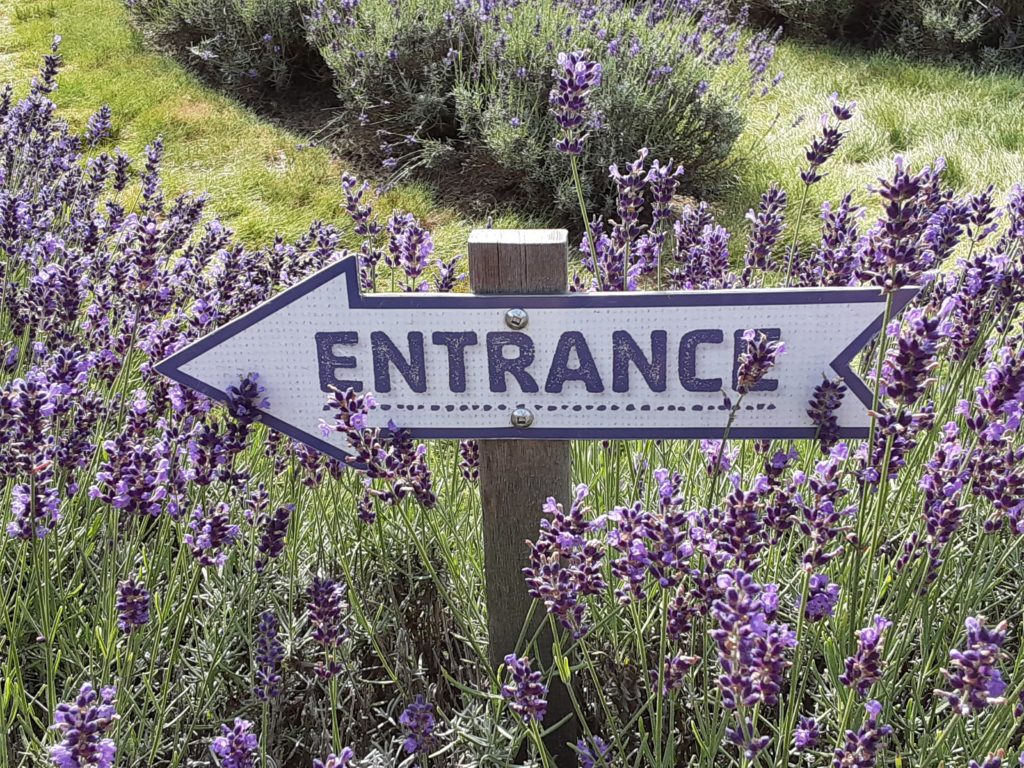
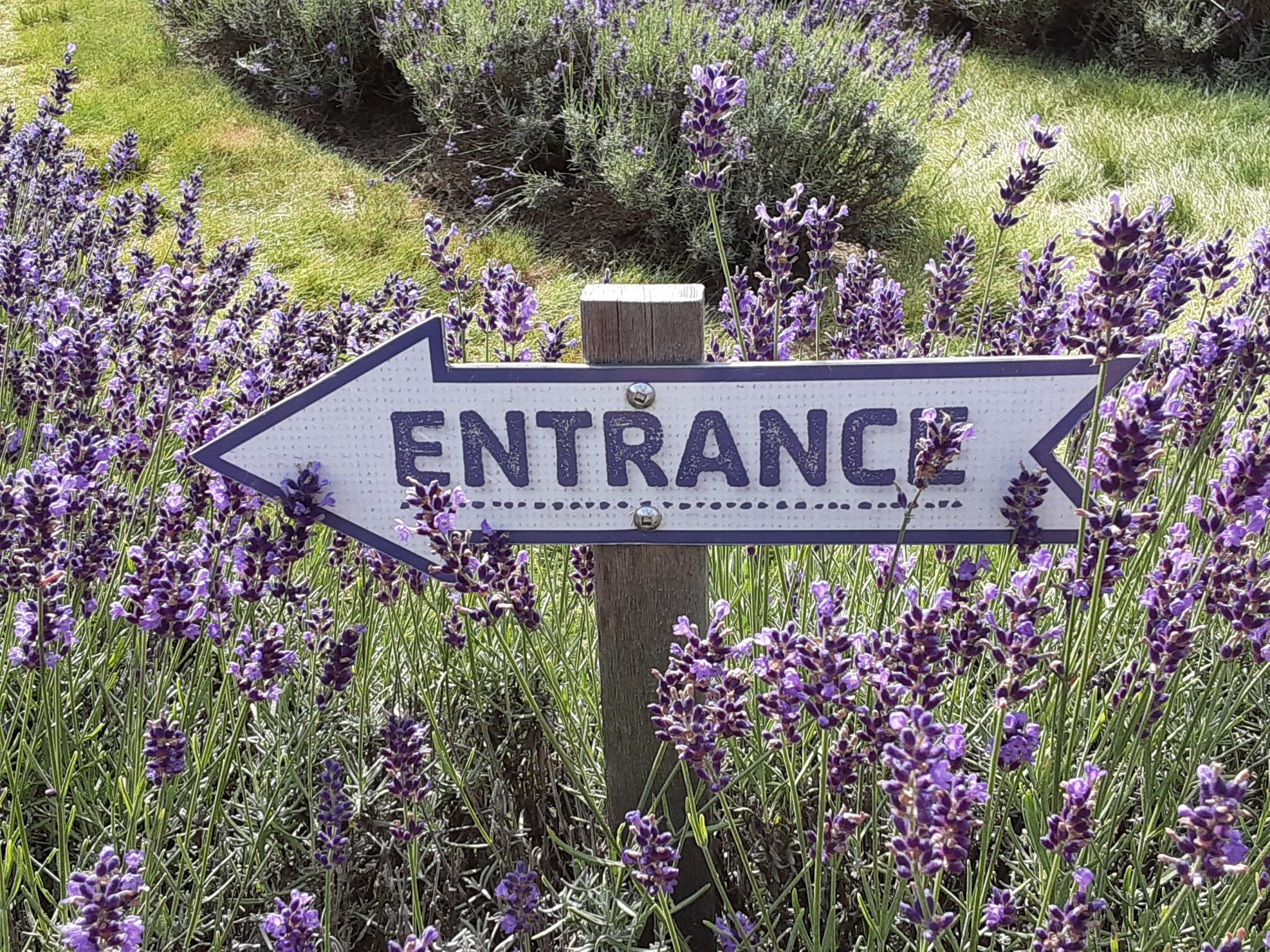
Wooden arrow-shaped sign with the word 'Entrance' painted thereon.

Entrance

Yesterday afternoon the sky cleared after a week of intense humidity ended by 12 hours of excellent, soaking rain. The sky turned that saturated blue of mid-century memory, and fluffy white clouds sailed across it, borne on the sort of breeze that billows washing on the line. By evening there was a hint of cool in the air. The sunset had a late-summer quality: oranges instead of reds; a skein of cirrus cloud instead of blue fading, ever so slowly, to purple. At dusk the crickets started up their chorus, as they do every year at the end of July, and around me I felt summer begin to grow long in the tooth. It was a good night for sleeping.

Wooden arrow-shaped sign with the word 'Entrance' painted thereon.
The lavender fields were entrancing.

Just over a week ago I spent a few precious days visiting my closest friend and her husband in Northumberland County. We’ve known each other for more than 25 years, after meeting at graduate school, and share many things in common, from cultural background to family history to intellectual outlook to a shared love of barbecue-flavoured potato chips from Giant Tiger. After two days spent visiting our usual haunts up-country, including Laveanne’s gorgeous lavender fields just north of Port Hope, Rice Lake and the inimitable Rhino’s at Bewdley, Millbrook (where we always stop in at the delightful consignment store The Joneses), we retired to her sunporch, where my friend (who has lived and worked in very hot as well as sub-Arctic places) mused that one of the reasons we appreciate summer so much in Canada is because winter is so long.

We sat there and sighed, and looked out at her beautiful garden, and considered whether the potatoes were ready to dig, because nothing epitomizes those low-angled days of late summer more than a feed of new potatoes, boiled and smashed and served with butter and salt.

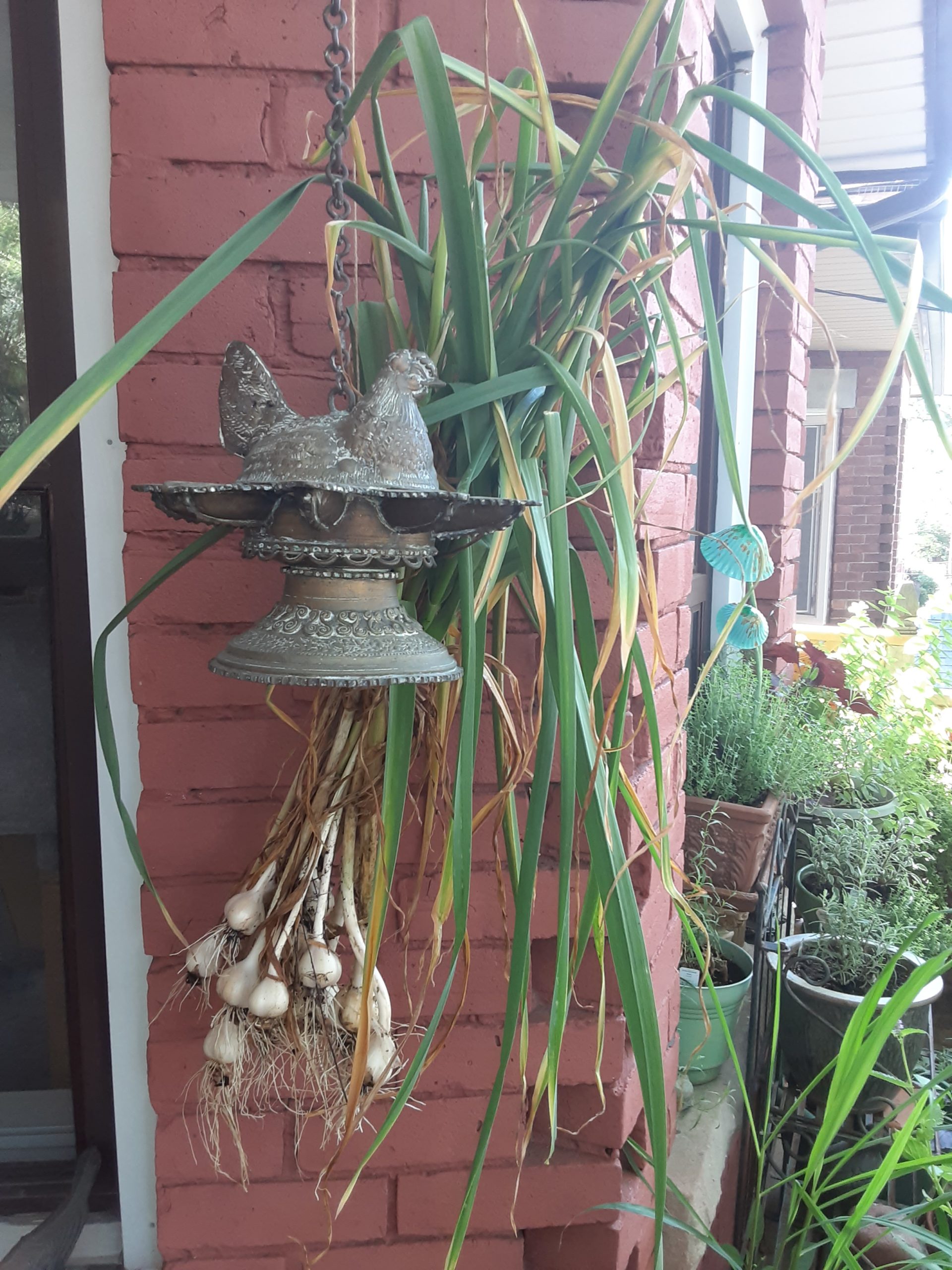
Back home in Toronto, I pulled fat tomatoes from the vine and snipped hot peppers and picked the last (well: almost the last) of the raspberries. I pulled the first of the garlic (good bulbs, not huge but the biggest I’ve grown yet) and hung them to dry and thought: it is the beginning of the harvest season. My herbs are due for a second cutting. I ran my fingers across the lemon verbena and realized: it is almost time to make jelly.

This morning the air is cool; the light pale. A merlin—a lady hawk, my neighbour calls it—swoops aggressively over the cedars with a staccato screech, hoping to flush small birds from the branches. I feel protective of the robins, who sound the alarm before regrouping and checking in with one another. Too soon the robins will begin to travel south, until one day in late September I will realize it has been a while since I last heard—or saw—one.

And I am just sitting here, typing, for the pleasure of feeling my fingers on the keyboard. No big thoughts here (I have several draft posts of those), apart from a growing conviction that every hour spent writing a blog post is a better use of time than scrolling social media. Yesterday afternoon, while doing research on a salad set of apple-shaped glass dishes I had picked up at Value Village, I happened across several blog posts (all dated five or six years ago; none of the blogs had updated since about 2018) and felt a deep sense of loss. Less than a decade ago, the internet ‘out here’ was a vastly richer and more open space, before social media platforms sucked the life out of it, absorbing nearly all public conversations into their maw and distorting discourse until it became almost unrecognisable. Online research itself has been flattened, as material that was once searchable has been sucked into proprietary platforms and search results themselves narrowed increasingly by algorithms spitting out results according to their whims. And then there is the disturbing problem of social media sites and search giants alike explicitly quashing news content.

Oops: no longer just typing. Deep breath.

Back to typing.

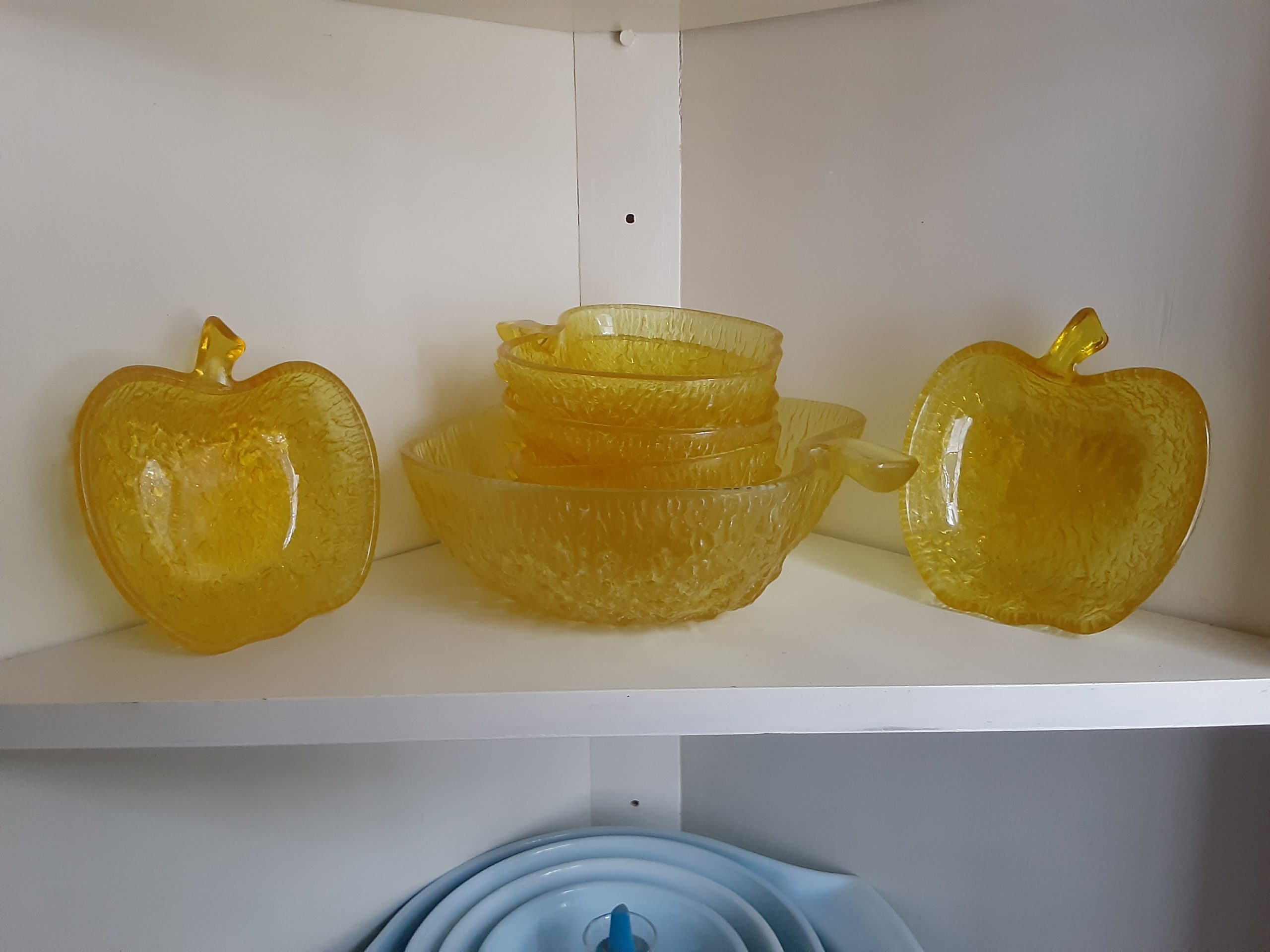
Set of translucent yellow apple-shaped bowls.
Ravenhead ‘Siesta’ salad set in bright yellow

Those apple-shaped dishes I bought the other day are, it turns out, from Ravenhead’s ‘Siesta’ line and date to the 1970s. The Siesta line was reportedly created by noted glass designer Alexander Hardie (under John Clappison) in 1973; Ravenhead was a well-known UK-based glass company. Weirdly, the images I am able to find online all show these dishes in clear or amber glass, while mine are a sunny yellow.

As summer grows long in the tooth, I am looking forward to using these dishes to serve out a harvest-themed salad (something with apples, nuts, cranberries, arugula and goat cheese, perhaps) in our shortly-to-be-renovated dining room, about which more anon.

And now, as the day warms (it is past eight o’clock, and the sun is cresting the cedars), I must shower and dress, and walk the cats, and find time to row, and tend to the day’s doings.

*

Afternoon update: I pulled the rest of the garlic, and made what may be this season’s final pick of raspberries. In a little while I’ll do a second cutting of herbs.

The sun is bright, the breeze is fresh, and I am soaking up every moment of peace.


Entrance Read More »

A Soul Among Souls

Last Sunday morning, for the first service after Epiphany, I put on a nice dress (fashion note, because one of my New Year’s resolutions is to celebrate the wearing of lovely clothes: I wore a long-sleeved knee-length woolen A-line dress in broad earth-toned horizontal stripes, tights, high brown boots and, to keep things real, a crow’s skull pendant), and walked down to what I have so quickly begun to think of as ‘my’ church. Each Sunday I look forward to walking the six blocks over to attend the service. I would go more often if I could. And so, while sitting in the beautiful sanctuary on yet another chilly, overcast morning, I thought about what keeps drawing me back.

It’s not the sermons which, while interesting and considered in their way, are pretty standard fare for the United Church. It’s not the congregation, or not yet: while I have met a number of parishioners and both ministers, we remain, in essence, strangers to one another. As yet I have no formal belonging to this church. At services I sing beloved hymns and say the Lord’s Prayer and join in the doxology, but speak no words to any person. I am merely a soul among souls, a presence among presences.

As an adolescent I spent a great deal of time—hours nearly every week—in the woods near my parents’ home on the outskirts of a Toronto-area suburb. Almost every day I would walk the lands behind our home, tracing a circuitous but purposeful path along the ridge, across a copse of goldenrod and skirting the edge of a cornfield before dipping down into the old millrace pungent with jewelweed, rising out of it near the adjacent farm’s old bottle dump and crossing the gravel road bordering the conservation lands that were my ultimate destination. Down in the ravine I would walk for more than a mile along the creek, paying attention to the perennial negotiation between the flowing streambed and its slowly shifting banks. High above me, especially in the fall and winter, the wind would roar in the trees, and they would creak slowly back and forth like disciples bearing witness to its power. In these moments my solitude was absolute; my sense of connection to the cosmos nearly complete. I was only breath; only movement; only soft footfalls on silty loam; only a presence among presences, a soul among souls.

The ravine was my church, my place of worship, and no religious service has done more than approximate the sense of immanence I experienced in those days in the woods, or in the awareness of wild creation I sense now in storm-tossed trees or in a waxing moon hanging low over the lake. The Holy Trinity that is Christianity’s core tenet cannot come close to equaling the power of creation present in a stand of trees and in a handful of soil, and in this I likely mark myself irrevocably as an apostate. But I suspect—oh, how I suspect—that theologians have known this for millennia, and that the rules of religious observance owe much of their rigidity to a compulsion to rein in the raw, self-abandoning consciousness of Creation, as if to regulate access to the God who is always already present in every breath of wind.

But still, there are the hymns—such a large part of worship in most Protestant churches—that so often and so evocatively deploy metaphors drawn directly from the natural world. Protestant hymnbooks positively bulge with them. Critics point out, somewhat accurately, that most of these hymns were written in and about pastoral England and are therefore dated, bland and culturally insular. Musicologists sometimes cringe at their prosaic lyrics and repetitive rhymes. And, of course, liberation theologues within the United Church demand, loudly if somewhat absurdly, that the Eurocentrism and coloniality of Christian hymns (and indeed Christian worship more generally) be exposed and decentered.

But the hymns, the hymns. The hymns are the Word embodied; the hymns connect earth-bound souls to the divine; the hymns are the living breath of a living faith. Through hymns congregants sing the same songs as wind and water; through hymns we may channel currents in the air and soil. Singing a hymn is an act nearly as sacred as walking in the woods and echoing in every sinew the creaking voices of the trees.

And so, at services I sit near the back of the sanctuary and stare up at the pillars holding up the broad wood ceiling as simply as trees holding up the sky. I sing the beautiful hymns, and practice my solitary faith, and consider whether belonging to a congregation will add to or constrain it.

A Soul Among Souls Read More »

All of Their Faces and All of Their Names

I don’t remember where I was on 6 December 1989. I do remember following the massacre on the news, and struggling to grasp its implications. At 17 my relationship with feminism was complicated; it is even more complicated now. But what struck me then, and strikes me even more strongly now, is that by “feminists” the shooter really meant “women.” That is what I remember, and that is what I think of 33 years later, in a year in which women’s lives and bodies and basic rights seem as much under threat as ever.

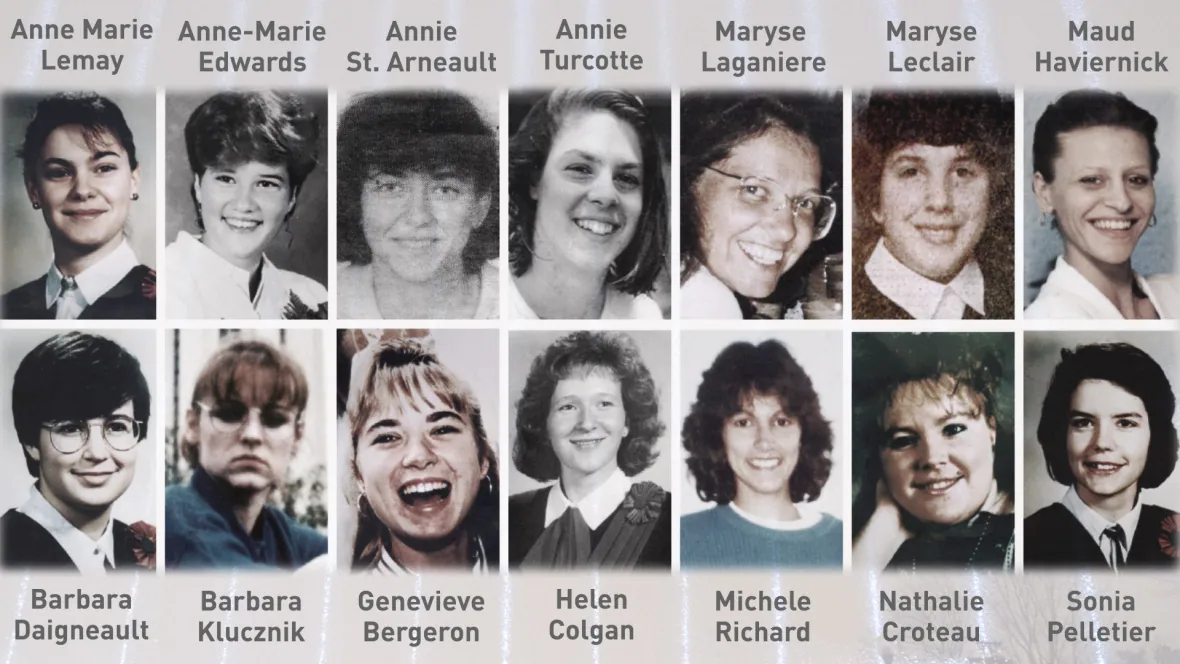
Twelve of the fourteen women murdered that day—Geneviève Bergeron, Hélène Colgan, Nathalie Croteau, Barbara Daigneault, Anne-Marie Edward, Maud Haviernick, Maryse Leclair, Anne-Marie Lemay, Sonia Pelletier, Michèle Richard, Annie St-Arneault, and Annie Turcotte—were engineering students. The thirteenth woman, Maryse Laganière, worked for the university. The fourteenth woman, Barbara Klucznik-Widajewicz, was a nursing student.

The women were young; the youngest twenty; the oldest 31. All were vibrant, accomplished, hard-working women, and as the years pass I find myself thinking, more and more, about what kinds of lives they would be living today. By now they would be in their fifties; two just past sixty; all likely at the peak of their careers; thinking about retirement, hoped-for grandchildren, ailing parents, new winter boots, vacation plans, the state of the planet. The kind of women one might encounter breezing into a smart café, shrugging the snow from their coats before sitting down to share gossip over lunch and a latte. Greying hair; a cancer scare; someone’s new love; variable rate mortgages; the fluctuating price of gas.

One of the women turns to another and asks if she has heard from Maryse lately, or Annie, or Helene, or Genevieve. A pause; a shaken head; a look of confusion. Oh; do you mean— I’m not sure; I don’t …

All at once the film recoils in its cylinder, stuttering briefly before rolling backward in a chaotic rewind. The projector shudders, lights flashing wildly; suddenly something rattles and pops and the whole thing derails. Metal shrieks, the reels rip loose from their casing, and in the background there is disembodied shouting. The film unspools into wild coils, frames snapping apart, stills spilling across the gritty floor.

Soon—but far too late for any hope of repair—all this tangle of metal and celluloid comes to rest, and in the profound, echoing silence punctuated by lights pulsing intermittently against the gloom, the only discernible images are those of the fourteen faces in an endless sequence of frames, eerily soundless and still.

All of Their Faces and All of Their Names Read More »

Second Sunday of Advent

Today is the second Sunday of Advent—the second Sunday of the Christian liturgical year, and also the second Sunday of my return to the fold after three decades’ absence from church—and it felt good, once again, to put on a nice dress, walk down to Runnymede United Church in the bleary December sunlight and sit in an already familiar pew in that beautiful sanctuary.

Celebration of the second Sunday of Advent  revolves around the theme of Peace, and I was quite curious to see how the Runnymede service would address this theme amid intersecting global crises, perhaps most pointedly the devastation and peril resulting this year from Russia’s invasion of Ukraine.

The readings—Isaiah 11:1-10 and Matthew 3:1-12, both traditional for the second Sunday of Advent—offer meditations that not only seem a bit incongruous amid the celebratory lead-up to Christmas, they advance complex, even paradoxical notions of peace. Isaiah promises the deliverance of God’s people, Israelites and Gentiles alike, alongside a veritable litany of peaceful outcomes: wolves lying down with lambs; calves with lions; wild creatures lead by a child; etc. etc.. But the text also calls for a leader or ensign who will “smite the earth with the rod of his mouth, and with the breath of his lips shall he slay the wicked.” The passages from Matthew promise salvation through baptism, but demand repentance. Both readings bristle with urgency, evoking barren, broken, battle-scarred landscapes (not only of the soul) that must be traversed before peaceful rivers can be reached and good rootstock (the defining metaphor in both passages) nurtured. The promise of peace—a renewed Covenant; the Kingdom of Heaven; the presence of a Savior—seems very real but distant, and difficult to secure.

As a member of Generation X, who grew up simply assuming we would all be bombed to annihilation in a nuclear Armageddon, and who then saw the tremendous promise of genuine peace brought by the end of the Cold War turned rapidly to ruin, simplistic invocations of ‘peace’ strike me as profoundly empty. The notion that one can just “say no to war”—as if aggressors will then simply go away and stop their genocides—seems to require an ignorance of reality that risks becoming complicit in the very evil it purports to oppose.

I am the only churchgoer in my household because my husband, an avowed if open-minded atheist, is also the son of someone who survived the Romanian Holocaust only because her mother sent her as a five year-old, by train with a near stranger, away from Czernowitz (now called Chernivtsi and, due to movement of the border, located in Ukraine) being ‘liquidated’ of its Jews, most of whom perished in Transnistria. It didn’t matter that my husband’s relatives were well-educated, secular, German-speaking engineers, doctors, lawyers and business people: they were still marked for genocide. And if the rescue of what remained of Europe’s Jews during the latter part of the Second World War was somewhat incidental to Allied efforts to stop Hitler’s conquest of Europe, it was nonetheless the result of a belated but real understanding that “peace for our time” will invariably fail if it remains willfully blind to murderous reality.

In this morning’s service the arduous, aching, perilous effort involved in any quest for peace was underscored by the choir’s simply superb performance of the haunting, powerful anthem “Dona Nobis Pacem,” “Dona Nobis Pacem”—or ‘grant us peace’—is, at its core, a simple, heartfelt plea, a short lyric from the Agnus Dei of the traditional Latin mass, sung as a round or spoken as a call and answer (which is how I have heard it in my church-going). The arrangement the choir sang so powerfully this morning was a somewhat recent one, prepared by contemporary American composer Z. Randall Stroope. If, like me, you have a prejudice against contemporary arrangements, Stroope’s setting will blow your mind. Seriously: have a listen here. It’s simply astonishing.

Stroope’s arrangement of “Dona Nobis Pacem” was a brilliant choice for this morning’s service because it appears (I say ‘appears’ because I am terrible at discerning lyrics without a printed text in front of me) to incorporate the words from Isaiah 11: 1-10, which was, of course, one of the readings for today’s service emphasizing both the promise of peace and the grave difficulty of achieving (let alone maintaining) it.

The city of Czernowitz / Chernivtsi, from which my mother-in-law’s family was deported in 1941, currently attracts refugees fleeing the Russian invasion in eastern Ukraine. Many of the refugees are children, five or six years old, like my mother-in-law was when her mother sent her away in hopes of ensuring her survival. Many of these refugees are headed in the same direction—south, into present-day Romania, because missile strikes interrupt even the provisional peace of a city so far spared the worst of the invasion.

In this morning’s service one of the ministers invited worshippers to consider the spaces and circumstances that bring them peace, and I thought about how often, in my experience and in human affairs more broadly, peace is provisional; how sometimes it reduces to a moment of remission in the furious face of disaster. I thought about how often peace must be fought for and defended with vigilance, like space or the right to exist. I thought about peace as a kind of mercy.

I also thought, as always, about my secret garden, where even in times of sorrow I commune with the bumblebees and witness the miracle of life unfolding in flowers and fruit. In this domain, which holds itself as much as possible beyond human affairs, peace is ingrained in the relationships between living organisms and in the flows of energy throughout the vibrant cosmos.

I find peace, too, in the wind that roars in the trees, and in solitary progress through the woods, and in moiling for fossils on gravel bars, and in a kayak gliding through lilies in an oxbow lake. In these moments there is no urgency; there is no crisis; there are no demands. There is only the movement of light and shadow, the slow motion of the earth; the voice of Creation saying: listen.

In moments of peace I pray for Ukraine.

Second Sunday of Advent Read More »