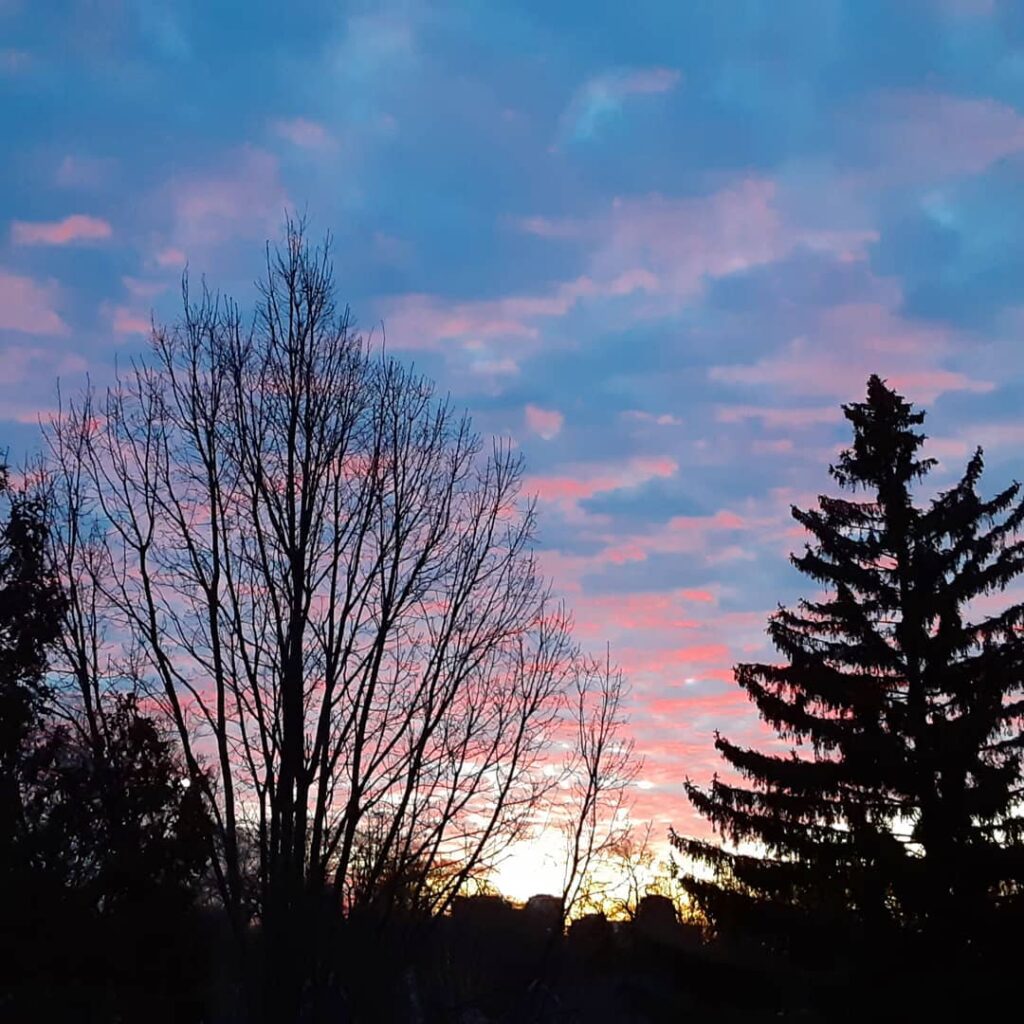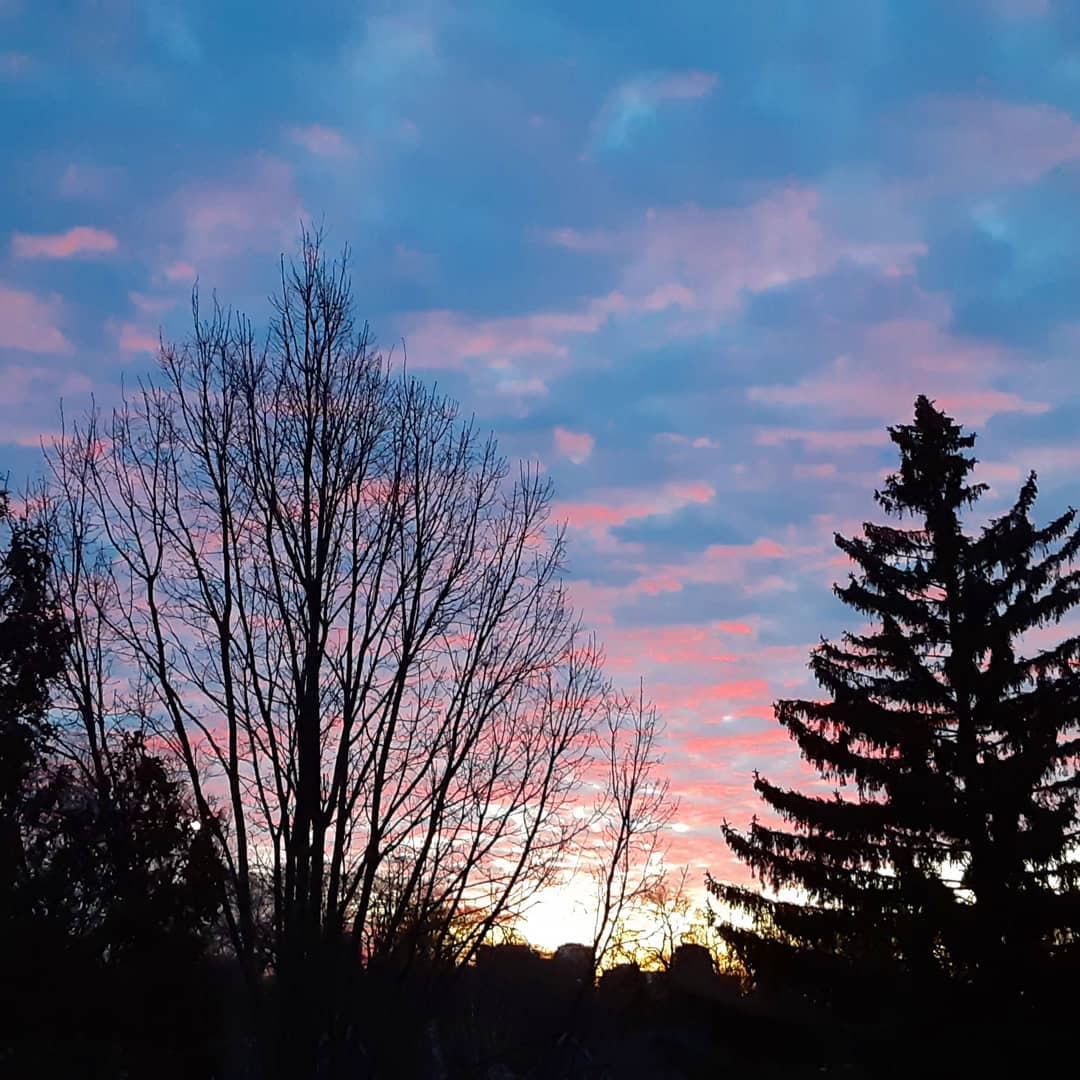
Six years ago, on the second day of the year, I took this picture from the rooftop deck of our home in the west end of Toronto. I like the way it captures the slow return of light to the hemisphere, silhouetting stark wintry forms in the middle distance.
Light returns: already the days are seven minutes longer than they were at the Solstice, with precious extra minutes of daylight currently noticeable mainly at dusk. Soon the sun will rise noticeably earlier, and when it does, around the end of January, the buds on the silver maples will grow fat and the crows will again begin to call.
Light also returns at night. The full Wolf Moon—a Supermoon this month—rides high overhead (at its fullest this morning at 5:03 am EST), and if the weather is clear this will be the best evening to view it, rising in the east right at dusk. In Toronto, the best place to view the full Wolf Moon is in a car traveling east toward downtown along the lakeshore, early in the evening. There is uncanny beauty in the city skyline laid out beneath the huge glowing moon. If the conditions on the water are right, moonlight illuminates the lake like a painting.
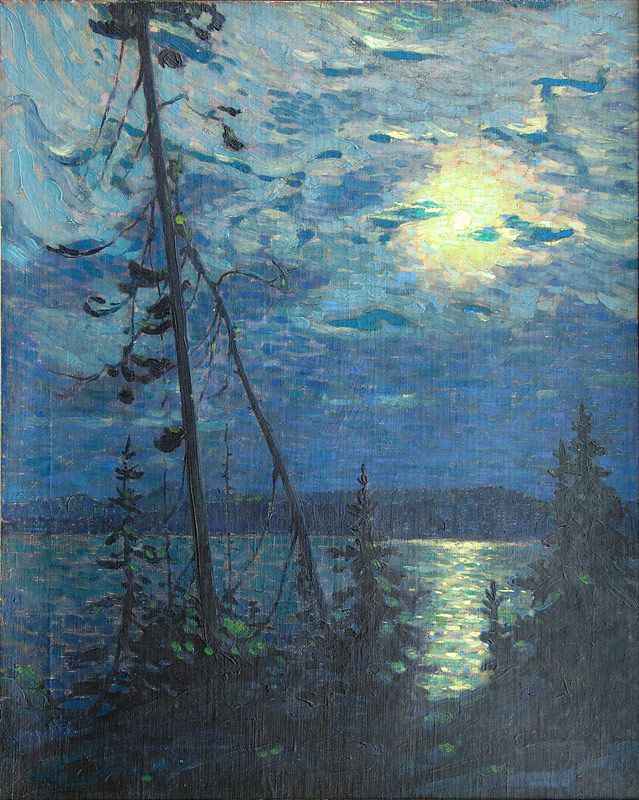
I have no good photos to share of the full moon over Toronto, so here is Tom Thomson’s luminous painting ‘Moonlight’ (1915-16).
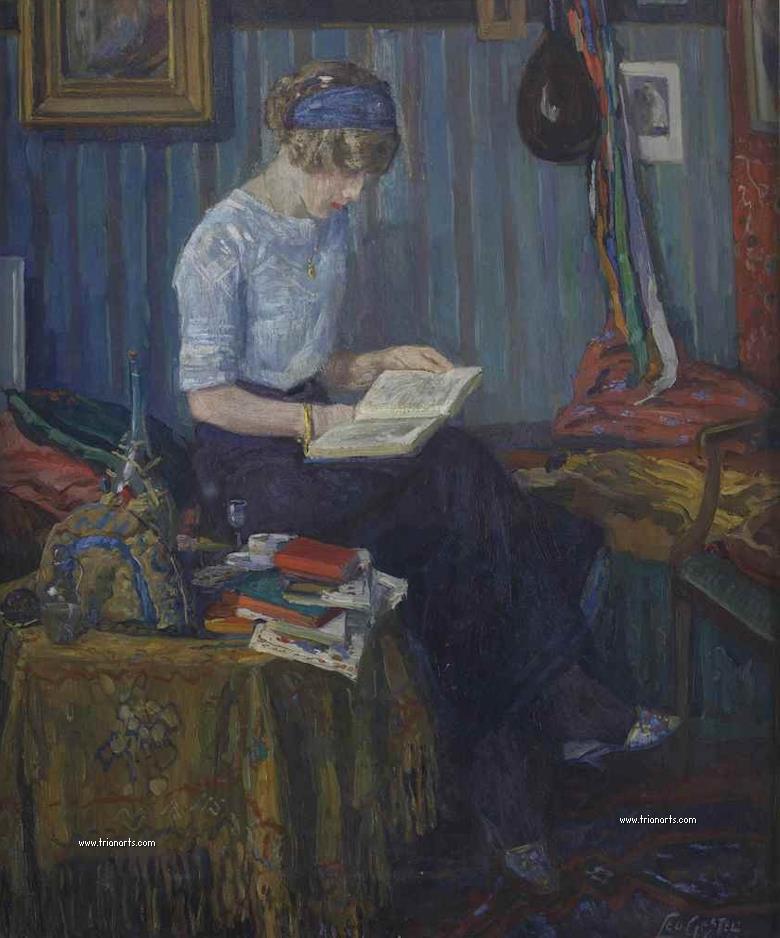
Leo Gestel, ‘Atelierhoek,” 1910 (signed, titled and dated). Oil on canvas, 52 x 43 cm
Leo Gestel (1881-1941) was a Dutch painter. This lovely work is ‘Atelierhoek’ or ‘The Studio Corner,’ winter 1910. Sold at auction in 2016 for 55,500 Euros, the original is reportedly held in a private collection. Wish it was in mine!
Described as a leading artist of Dutch modernism alongside Piet Mondrian and Jan Sluijters, Gestel’s work exemplifies the new art styles emerging in early twentieth century Europe, from cubism to expressionism to neoimpressionism. The above painting strikes me as mainly neoimpressionist, while retaining some cubist elements.
I like the reader’s contemplative pose: absorbed in her books, she has little concern for her observer.
There appears to be little scholarship on Gestel available in English, and only a few biographical details are available online. Gestel’s father Willem was reportedly also an artist. As a young man Leo was introduced to Avant-Garde artists and exhibited in Paris and Berlin. In 1914 as the First World War broke out, Gestel sketched chaotic border scenes of Belgians fleeing the widening conflict, and sold lithographs of these sketches to raise money for the Committee for Refugees. A fire in 1929 destroyed much of Gestel’s work; he died in 1941, reportedly from a longstanding stomach-related complaint.
The Cultural Heritage Agency of the Netherlands reportedly has custody of many of Gestel’s surviving sketches, notebooks and papers: fortunate are those who are able to access these materials readily!
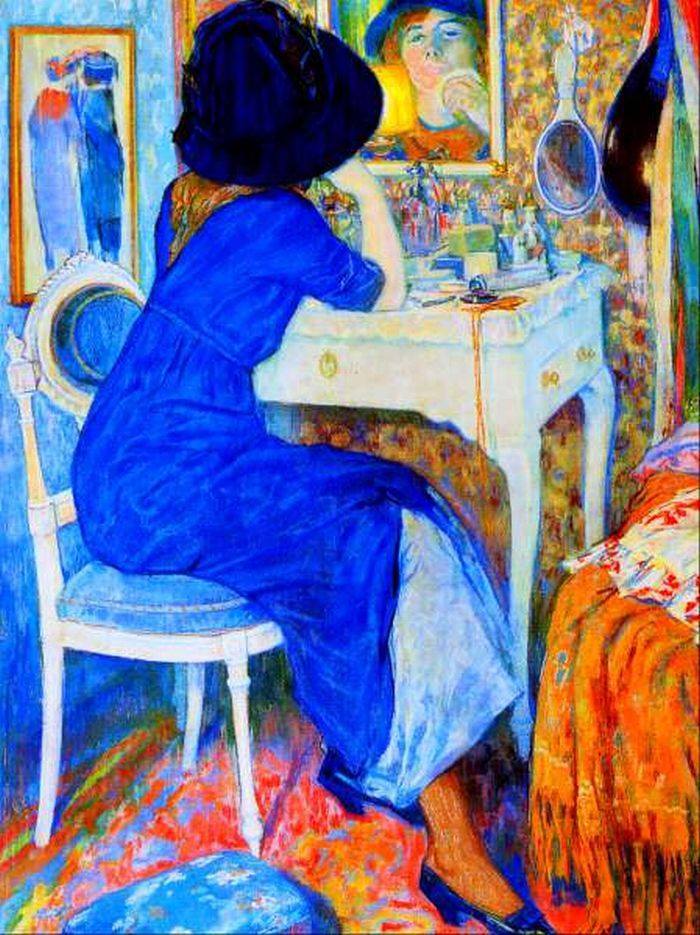
Another Gestel work I like a great deal and sometimes use as an online profile picture is ‘Lisette at Toilette’ or ‘Woman at Make-up Table, 1911, painted in a similar style although in far brighter tones. Note the image hanging on the wall, which is likely a cameo of another of Gestel’s paintings.
Leo Gestel, ‘Lisette a Toilette’ or ‘Woman at Make-up Table, 1911.
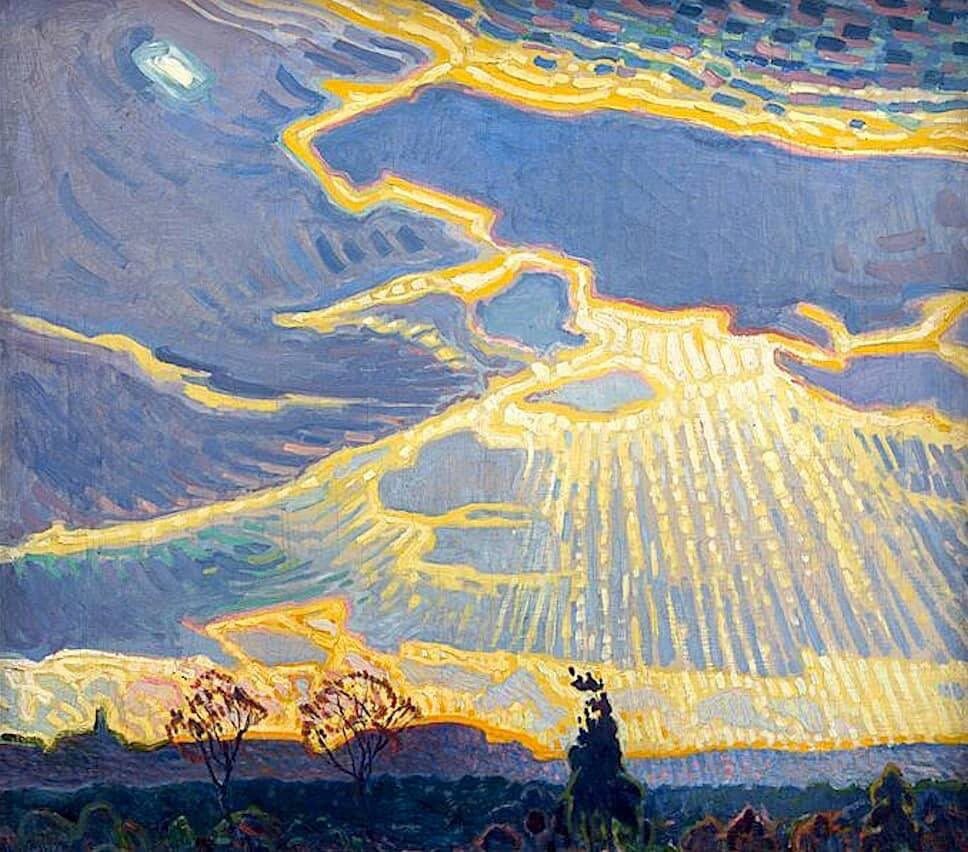
There’s also this beauty, reflecting the influence of luminism in his work. Reportedly Gestel became interested in the play of light upon landscapes. ‘Herfst’ (or ‘Autumn,’ 1909) is an excellent example of his work in this area (and cannot help but remind me, as a Canadian, of some of Lawren Harris’ work). This painting is held by the Museum Kranenburgh in Bergen, where Gestel lived and worked for a period.
Leo Gestel, ‘Herfst’ or ‘Autumn’ (1909). Oil on canvas, 53.5 x 61 cm. Museum Kranenburgh, Bergen, Netherlands
Here’s Gestel himself, photographed later in life and in a youthful self-portrait (1913).
Leo Gestel photograohed.
Self-portrait, 1913.
A note about this post: my initial plan was simply to share the first image, which so well evokes the contemplative mode suited to the beginning of the year. Unfortunately the quality of information available on the open internet has declined so precipitously (and in fact has been in steady decline for the last decade, as any researcher can confirm) that I had to dig quite deeply to find accurate information about the painting. The upside was that I learned more about Gestel (until today he was little more than a name), and encountered much more of his surviving work. I am sharing some of this information here as part of a commitment to ensuring decent quality information continues to be available on what remains of the open internet.
There are a number of print exhibition catalogues and/or retrospectives on Gestel’s work, available in Dutch. If you know of any material available in translation, I would be grateful to hear from you!
During the long night of winter the city pauses, midway between dark and day. It goes on like this for weeks: each bleary dawn, the fickle light, the slow descent into twilight. There are consolations, however. A morning sky like burnished silver; the sly moon, gliding across the landscape. After a snow the light is brilliant, and on the first day of the year we dredge for hope in its drifts.
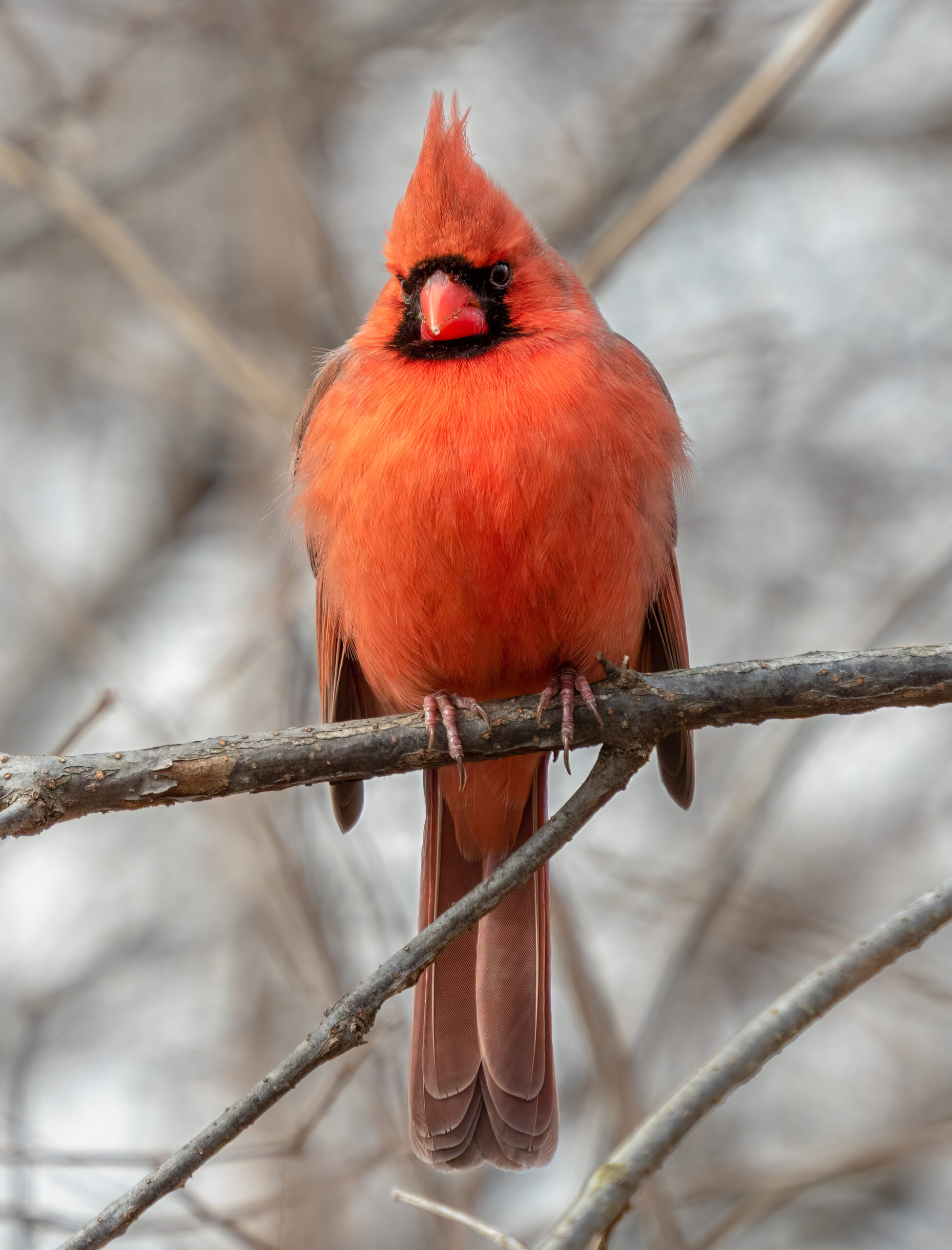
All the things we might love appear without warning, appear out of nowhere, like the red bird in winter that turns the season toward light. The winter swells like a wound; it wells up in us; suspends us, our shovels frozen in mid-air. We are like mammoths, fossils imprisoned in ice until something in us trickles free, until the crystalline structure shatters and we move again, flowing toward the light.
On the first day of the year the houses across the alley loom like old ghosts. They waver in a squall, their shape traced and erased by branches. A cardinal lands in the cedar, sings despite the storm. A light goes on in someone’s kitchen, a kettle scrapes across the stove. And rapidly I dress and put on my coat, and go out to greet the year.
[A version of this post appeared at Reading Toronto on 1 January 2008.]
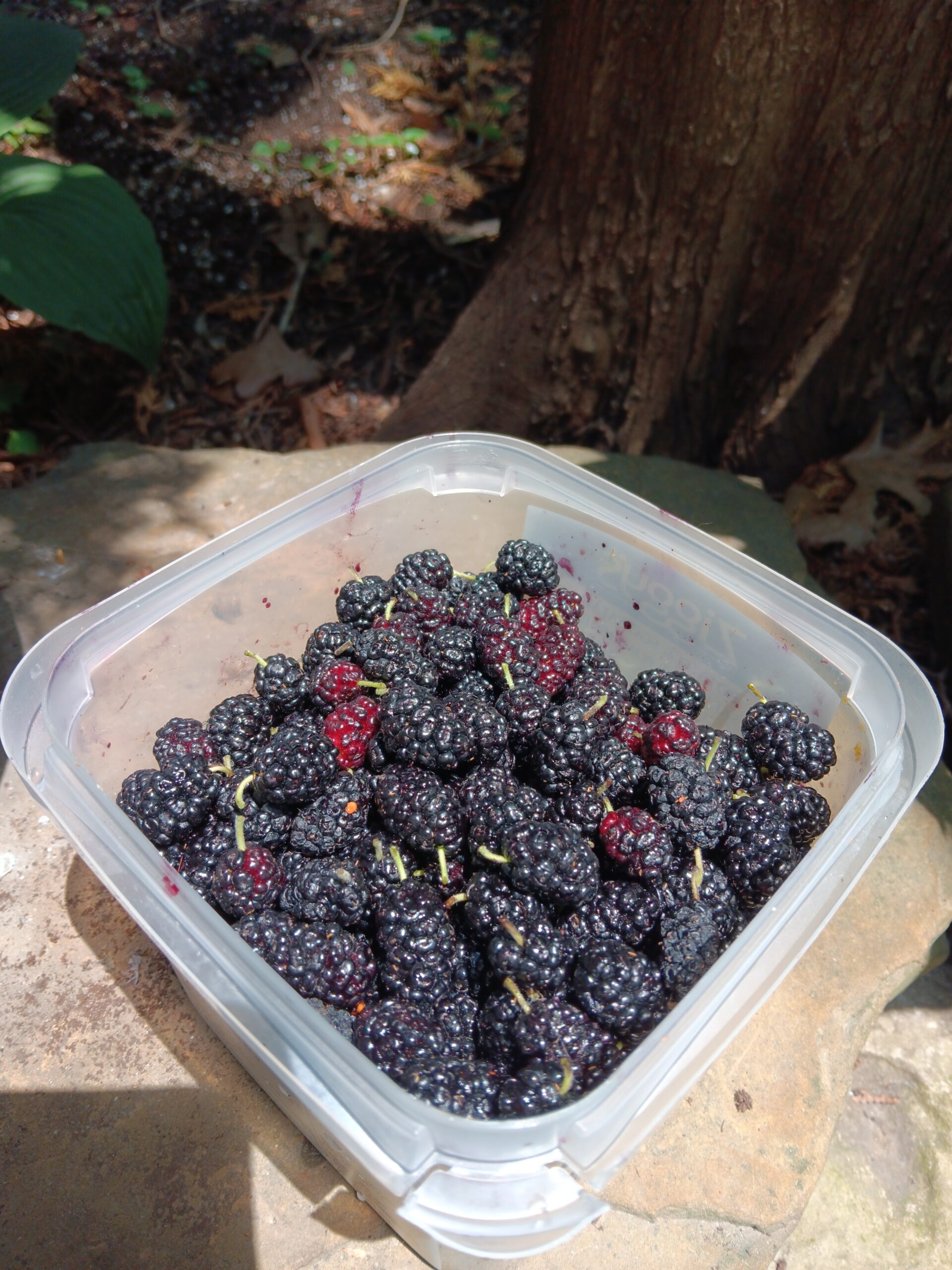
First pick of mulberries today. The street trees we usually pick from have had all their lower branches pruned in a hopeless (I dare not say “fruitless”) effort to reduce the masses of mulberry fruit squished into jam on local sidewalks, but about a kilometre away I found a street tree laden with low-hanging fruit and, with the property owner’s permission, picked about 4 cups.
Mulberries have a sweet and slightly tart taste. They make excellent mulberry-lavender ice cream, very good jam, and are an unbeatable companion to dark chocolate. They also stain strongly, and would likely make excellent purple or burgundy dye or ink. Like most berries, they freeze easily for use throughout the year—a good thing, because mulberries in the Toronto region fruit briefly, a week or two before the raspberries are in full swing, from late June to mid-July. The best mulberries to pick are the fat, long ones that detach readily from the branch. Mulberry trees with eastern exposure seem to produce the sweetest, fattest berries.
Mulberry trees are somewhat controversial in native plant circles, mainly because Asian white mulberry trees (Morus alba), reportedly introduced to North America in the 1600s, have replaced or hybridized with native red mulberry (Morus rubra) and are therefore considered invasive. Native red mulberry is severely endangered in Ontario: reports from 2014 indicated that there were only 217 red mulberry trees remaining in the province, clustered mainly in southwestern Ontario.
Personally, I am on the fence about hybridized mulberries. I am always open to correction, but currently it is my non-expert impression that the proverbial ship may have sailed on the prospect of restoring a sustainable population of non-hybridized red mulberries in Ontario. I am not convinced it is possible or even desirable at this point to eliminate hybrid trees. Having said that, at least two native red mulberry trees are on my wish list for Maher Circle and, if we are able to procure some for our native pollinator garden, I will endeavour to maintain a 50 metre clearance between our natives and any non-native or hybridized mulberries.
In the meantime, however, I am happy mulberry season has begun, and hope over the next week to pick a year’s worth for the freezer, of which a quantity will go into a batch or two of delicious mulberry-lavender ice cream.
Today is the third of July, and my raspberries are producing fruit. The first ripe berries, hot in the sun, always, are reverently consumed: sweetness on the tongue. Afterward, most of the berries go straight into the freezer until I have enough to make milkshakes, ice cream, and jam.
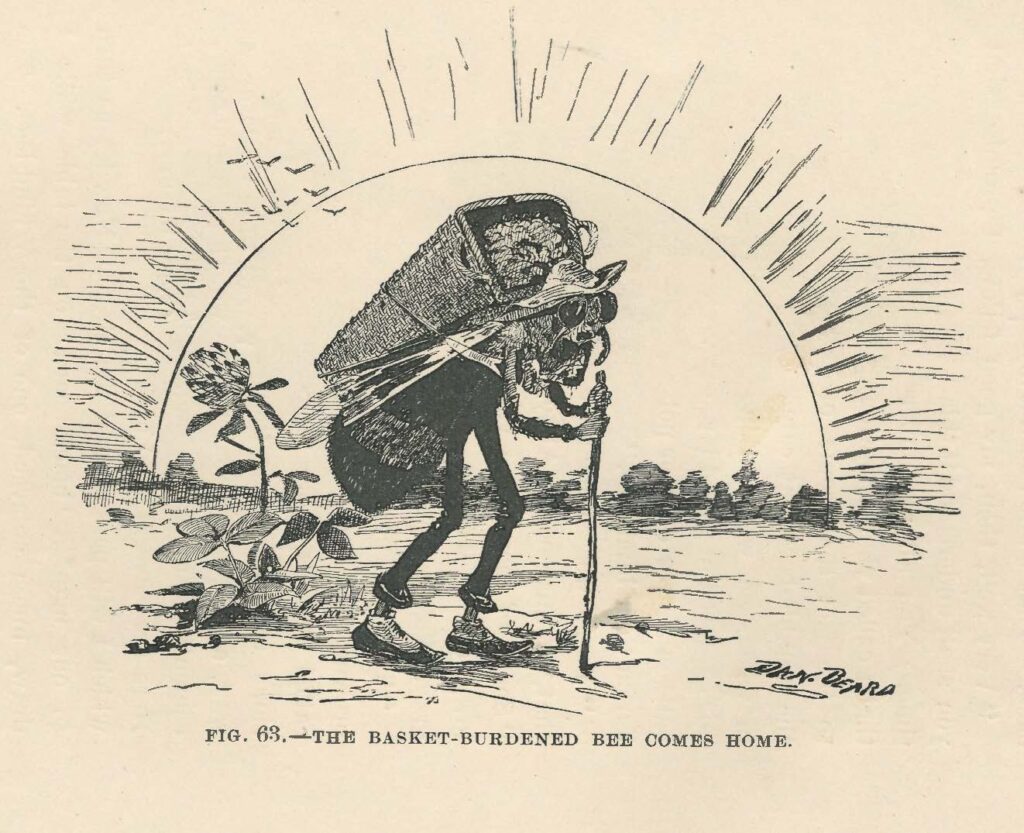
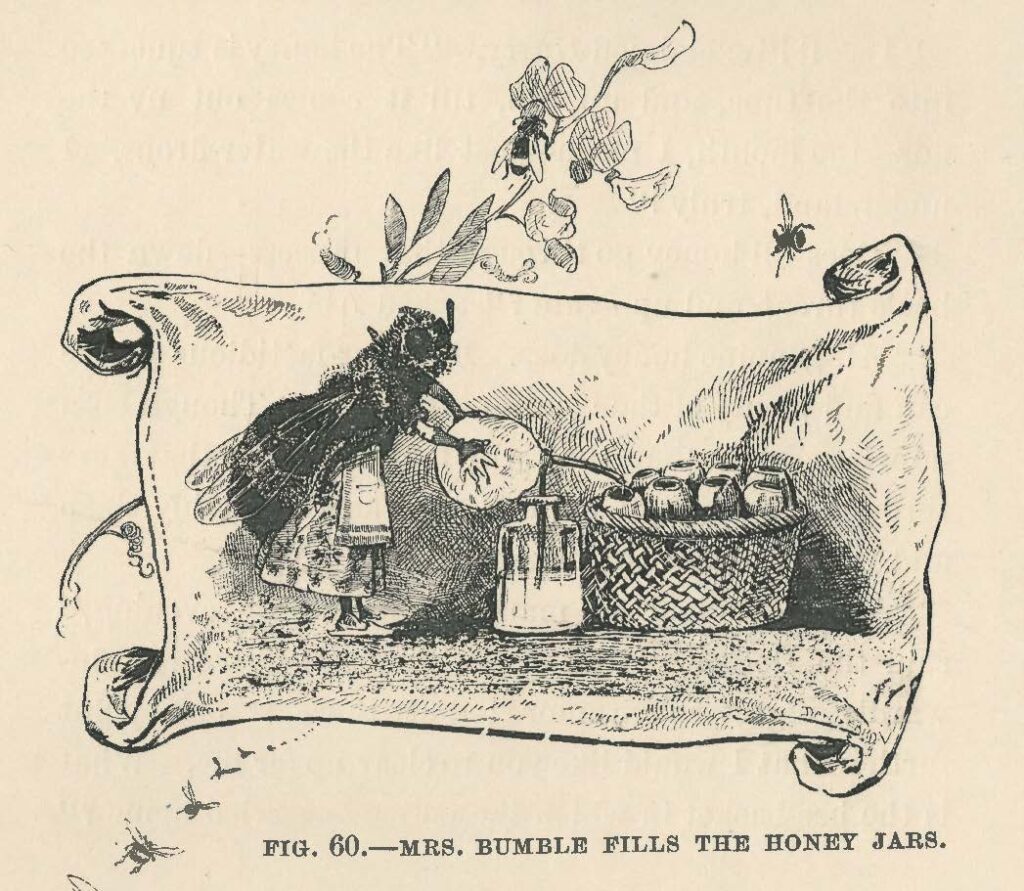
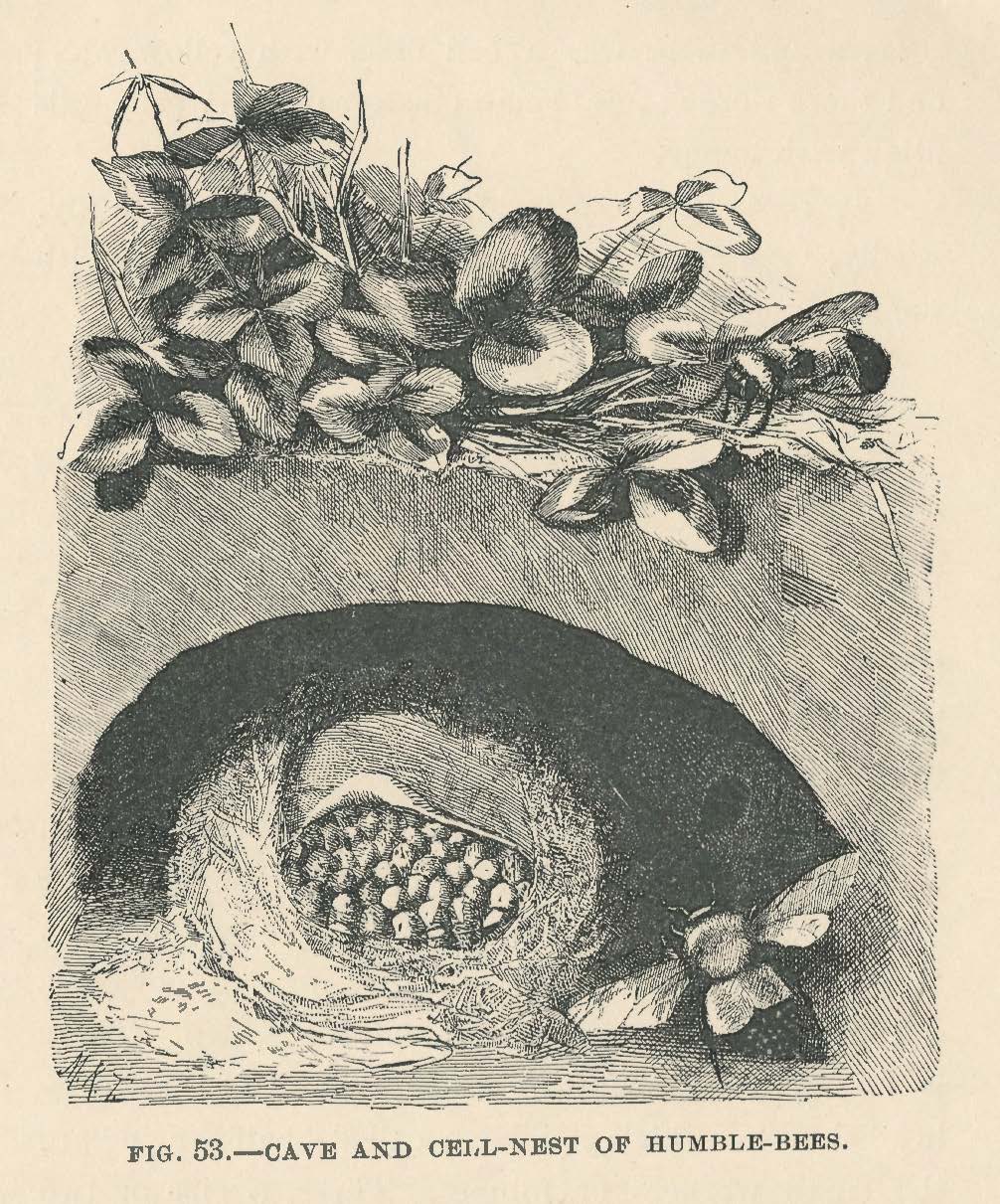
Reverently, too, we observe the bumblebees who pollinate the flowers and are therefore the raspberries’ principal keepers. Here is one, hard at work a few days ago, a producer of miracles in summer sunlight.
*
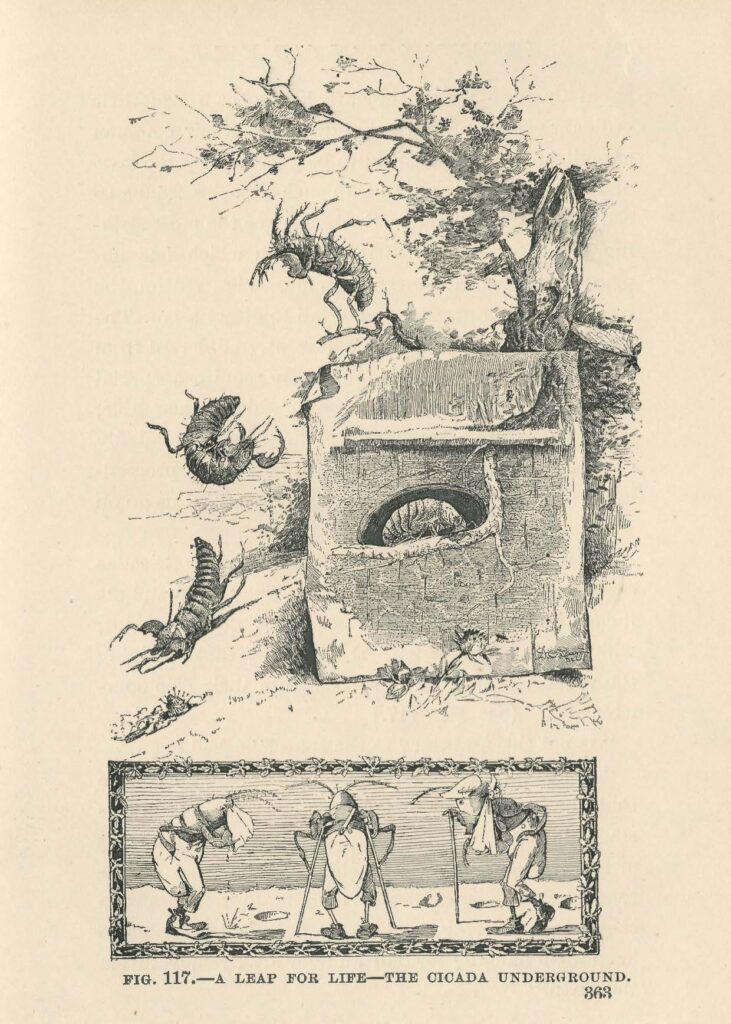
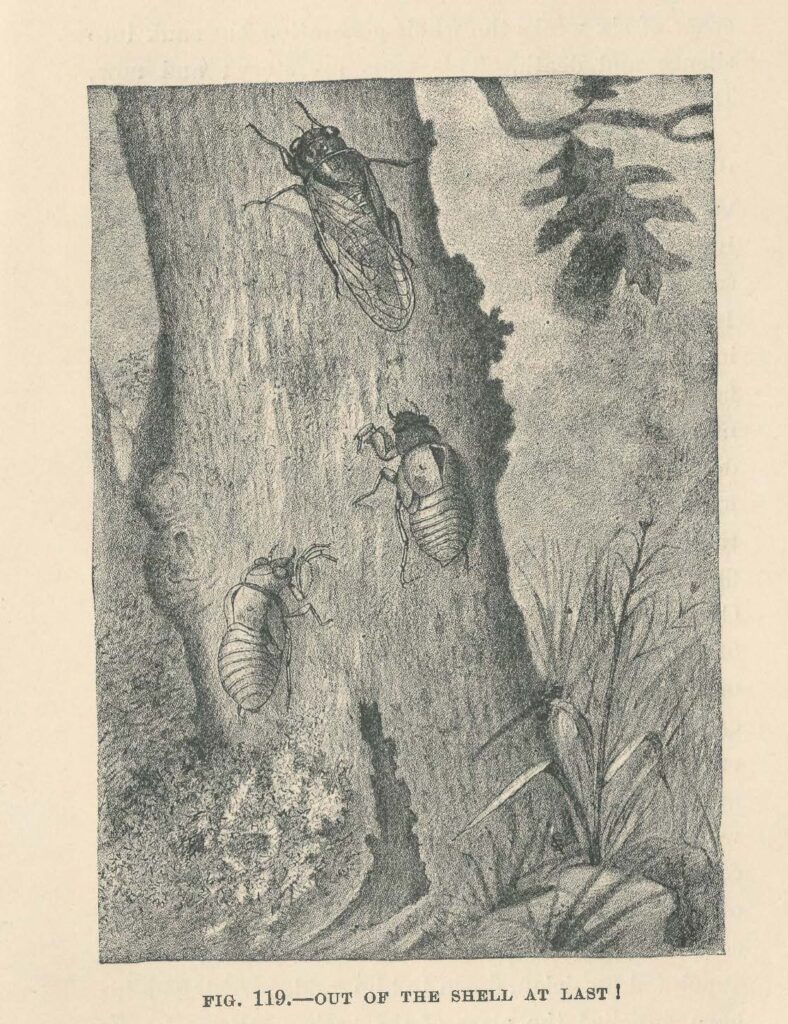
The cicadas are in season, too. I heard the first one of the season late yesterday, as the humid evening eased itself into dusk. I heard it again this morning, and hopefully soon we will have a loud chorus of cicadas, droning in the summer air.
*
Also, seen recently in my woodland garden: a male blackburnian warbler! I am terrible at bird identification, and my phone camera managed only pixelated pictures, but blackburnians have such distinctive plumage that it was fairly easy to narrow down the species while flipping frantically through my collection of field guides. I assume this bird was in transit and stopped by my woodland garden to shelter under the cedars and enjoy the bird bath.