Packing Christmas Away

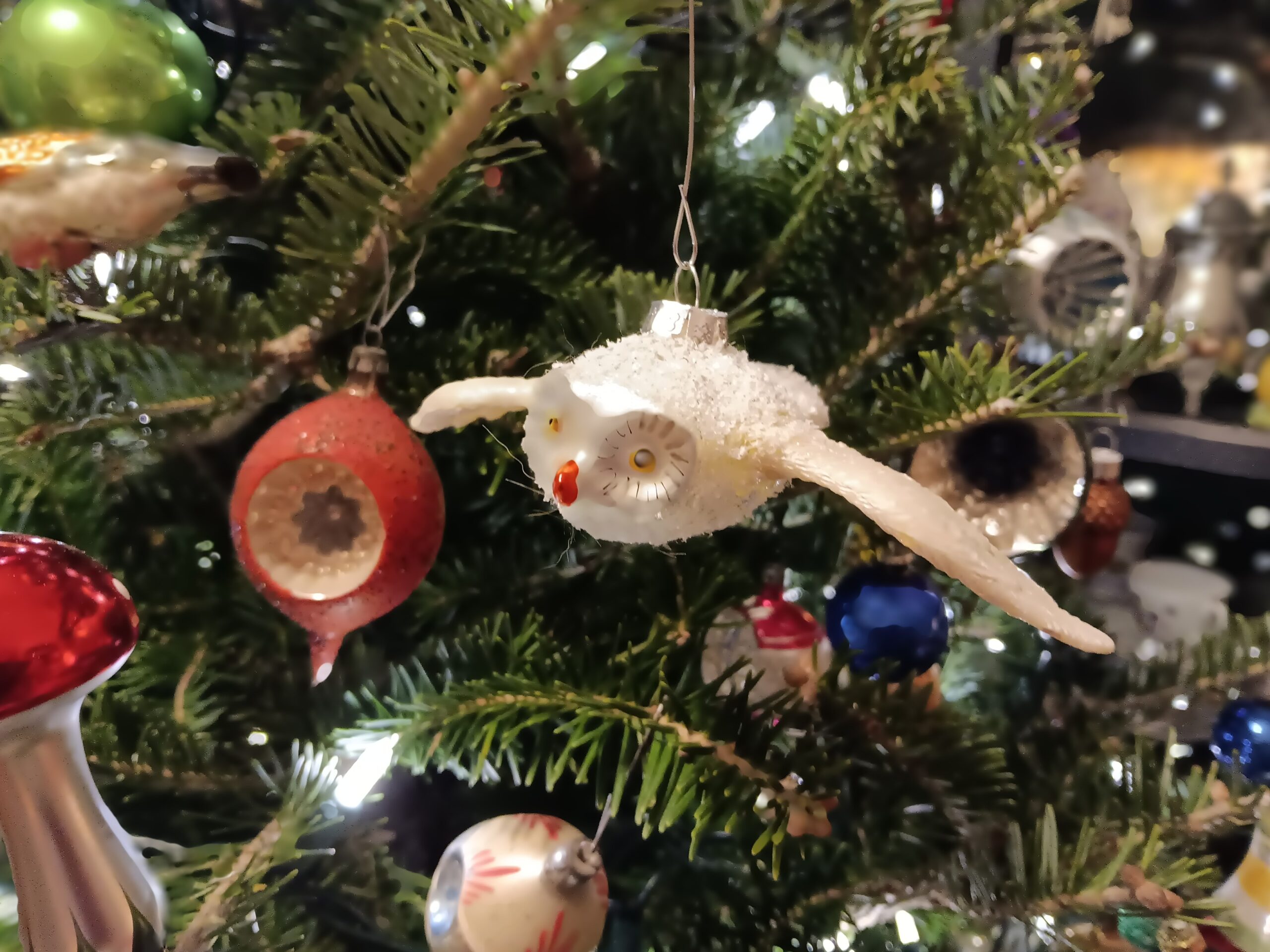
snowy owl ornament on Christmas tree

Today I’ve been packing Christmas away—a necessary if somewhat melancholy task. But Epiphany has passed and, more importantly, it was sunny today and warm enough to take down the outdoor lights. Winter weather will return to southern Ontario on Saturday, and after this it could be March before we’ll have another mild and sunny day.

When I went out onto the front balcony to take down the second floor lights, I realized a squirrel had chewed the wires. Poor squirrel—hope it recovered from what I presume must have been a shock! And poor lights! Next year I’ll hang a slightly shorter strand of outdoor lights over the balcony that will be difficult for the squirrels to access.

This evening after dinner I’ll untrim the tree, and then take it out to the back garden and stand it in a corner to offer winter shelter (and an extra hiding spot from hawks) for the little birds who frequent our feeder and the opossum who occasionally makes a quiet appearance.

If I had my druthers and was a little less exhausted after Christmas, I’d do what I used to do, which was untrim the tree on New Year’s Day, in order to start the year with a clean slate. The purists would have us wait until after Twelfth Night, and fair enough, but it is also perfectly reasonable to want to put away the bright shiny things after a month or more of holiday-related frenzy activity.

I am very fond of ‘shelter’ magazines (particularly those focusing on vintage or ‘country’ decor, although over the years I’ve subscribed to everything from to House and Home to Architectural Digest)  and, after the flea market-themed summer issues (although sadly, to my knowledge Architectural Digest has never had a flea market issue—it totally should!), my favourites have always been the January-February issues, which reliably feature pale colours and peaceful, serene settings.

I love the idea of a January re-set. I love seeing pictures of soft mauve throws layered against clean-lined grey sofas with low stacks of curated art books set just so atop rustic coffee tables in the foreground and pale winter light casting its restful glow over the peaceful scene.

Maybe this year I’ll manage, in this serene season, to clean off our own coffee table well enough to reliably find the television remote!

Packing Christmas Away Read More »

Not Afraid

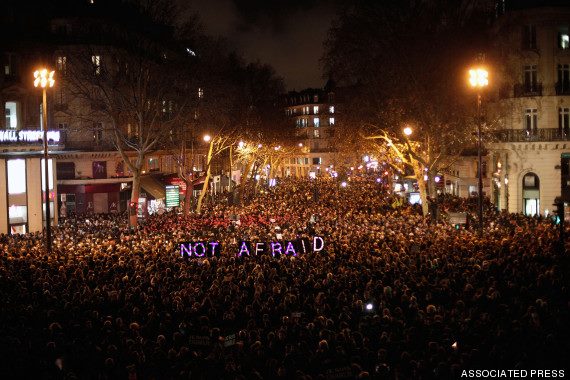
NOT AFRAID in Paris, 7 January 2015.

On this day in 2015, terrorists murdered twelve journalists at a Paris-based satirical newspaper. That night, tens of thousands of Parisians rallied in a powerful demonstration of defiance and strength. In the following days and weeks—even as terrorist attacks continued (reaching a bloody crescendo that November, when 130 people were killed in coordinated attacks across the city and its suburbs)—the rallies grew progressively larger, eventually attracting millions. The slogan “Not Afraid” became a rallying cry.

In a self-contradicting and point-missing column published a day later, a Guardian writer argued that that “Not Afraid” slogans were ultimately a hypocritical pretense, intimating that the 2015 attacks would inevitably generate an “overreaction” while also arguing that, despite the terrorists’ own statements about acting on behalf of a hoped-for Caliphate, they could be seen as decades-delayed retaliation for National Police officers’ killings of Algerians in 1961. With a perverse or perhaps merely dialectical fatalism he concluded, “We are all prisoners of our history.”

Today’s pundits, in efforts to account for exploding ideological extremism in the West and the attendant (but which is the chicken and which is the egg?) surge of authoritarianism, wonder aloud whether the pandemic broke people’s brains (likely: it certainly damaged public trust, mainly in concert with the following phenomena), or whether social media is to blame (yes they are: more on that anon), or whether hostile foreign states have succeeding in their long (and long-avowed) game of undermining liberal democracies (absolutely, although not without enthusiastic support from inside, especially recently, on both ends of the political spectrum).

Still: I think the hapless Guardian columnist inadvertently put his finger on the pulse of the problem.

Liberal democracies—far and away the most innovative, productive, equal and inclusive polities—stand out because they enable us to not be “prisoners of our own history.” This is, of course, what dictators hate most about democracy, and why their regimes so reliably attack democracies. How can authority possibly be absolute; how can entire peoples be subjugated to the will of the leader; how can history itself be made into a monument to his power if people are free to make and remake their own futures?

Democracy’s unique strengths and the unique freedoms it enables do not mean democracies aren’t vulnerable. Too often we have squandered the dividends of democracy, treating it as an inexhaustible resource rather than a living entity that needs nurturing if is it to continue to offer sustenance. That this is a problem of the left as well as the right cannot be overstated.

We should have remained more vigilant. Now the hour grows late, and there is a rising torrent of attacks against democracy—from without and within—that calls on our courage to stand up and be Not Afraid to defend it.

Because if we are afraid to defend democracy now, we will find ourselves vastly more afraid without it.

Not Afraid Read More »

Winter Light

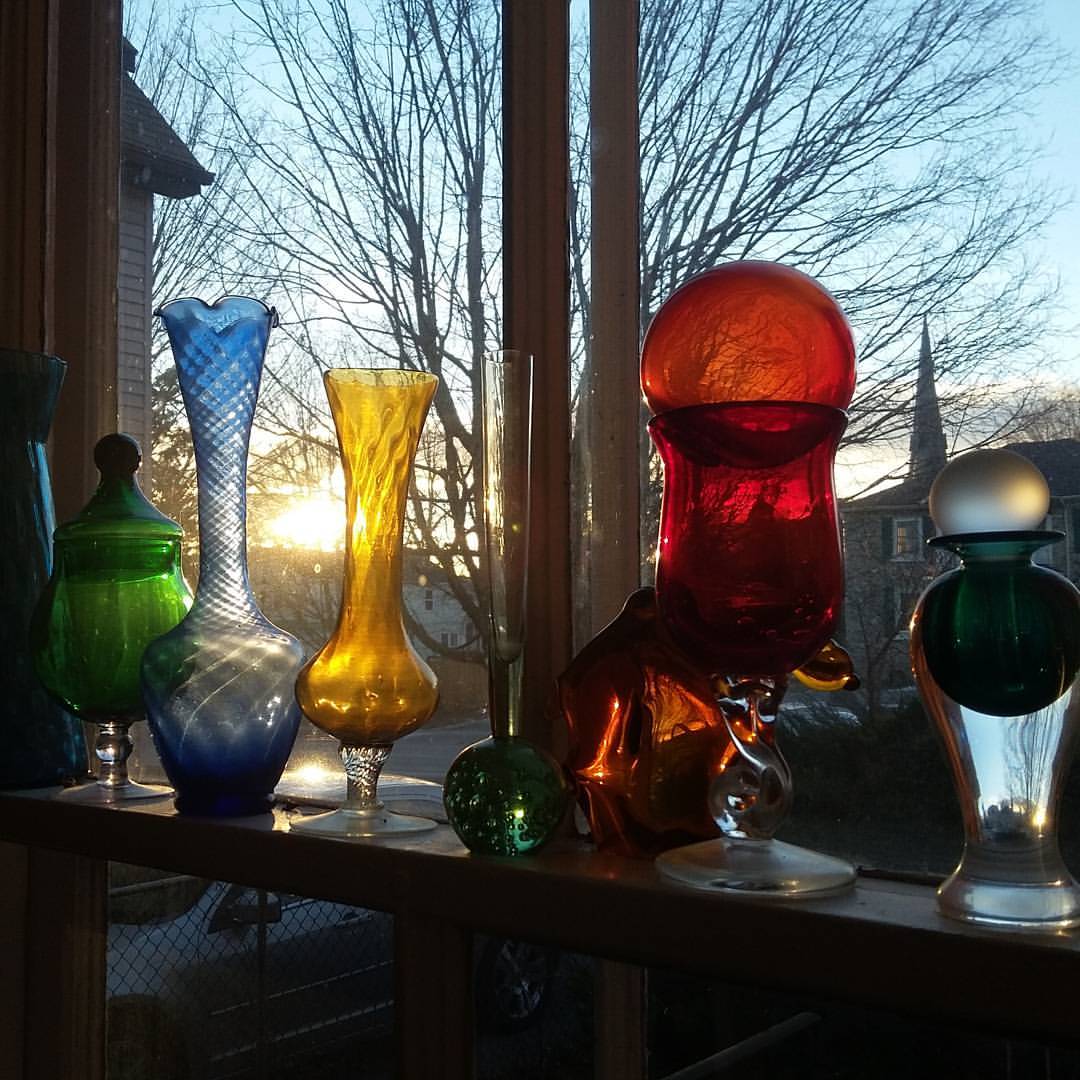
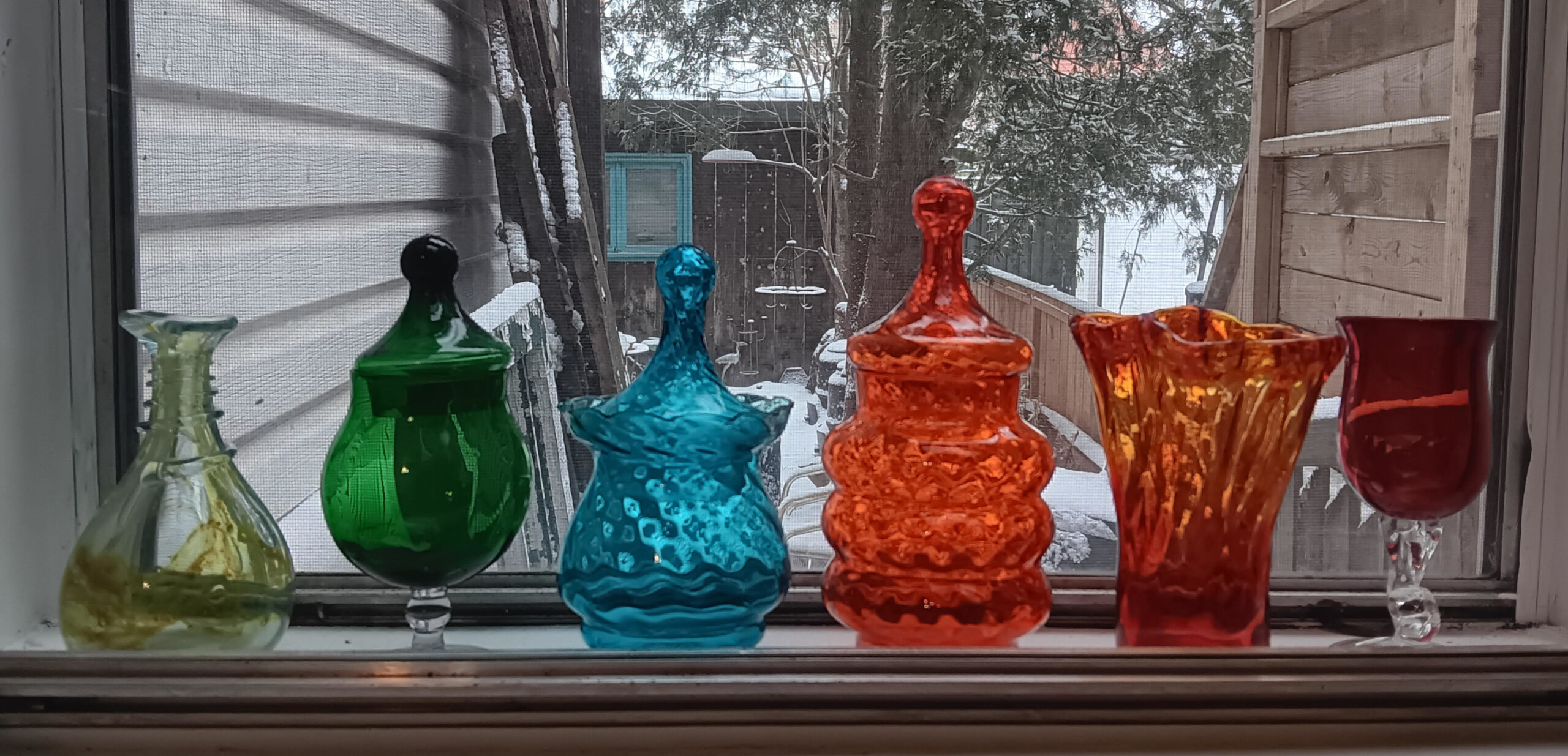
Coloured glassware gleaming in a window.

Yesterday I came across the above image, taken on the fifth day of January 2017 at my mother’s house. I gaped at it for a moment and then looked over at my dining room window and back at the image. Different window; (some of the) same art glass, capturing winter light.

Coloured glass in a window with winter scene in the middle distance.Winter light is a precious thing. Even after the Solstice, with the promise of light returning to the hemisphere, January and the first part of February are usually gloomy and overcast. This is the season of hibernation and drift, when some deep impulse tells us to go to ground. When light penetrates—a glint of dawn before the storm front descends; the glare of low-angled daylight on ridges of ice—its intensity is startling.

This is the season of streetlights guttering in the wind, of houses aglow on snowy nights—and of coloured glass on a window-sill, collecting and dispersing light.

A note: today is Epiphany,  which in the Christian faith marks the visit of the Magi to the newborn Christ child. Epiphany is a day of illumination, a reminder to look toward the light in a time of darkness.

Winter Light Read More »

Ice Discs on the Gananoque River

ice circles on a slowly flowing river in eastern Ontario, January 2017

This photo, taken in January of 2017, shows ice discs on the Gananoque River in Ontario, Canada. It was a frigid winter day, and these ice discs had formed in the lee of the current immediately downstream of a dam and waterfall in the river. The ice discs swirled in the current, bumping against each other as new discs formed, likely calving off the patchy ice near the shore. It was a remarkable thing to see on a very chilly walk overtown from my mother’s house.

Ice discs are reportedly an uncommon phenomenon and are the result of rotational shear influencing the formation and shape of ice in cold climate rivers. Some ice discs grow very large, measuring tens of metres in diameter. The discs I photographed in the Gananoque River on that frigid January day were much smaller, averaging about 10 inches (25 cm) across.

It turns out I am not the only person who has noticed ice discs forming on the Gananoque River: these wonderful images of ice disks were taken by photographer Deb Keogh in January of 2025, also on ‘the Crick’ below the dam. Conditions on the Crick that likely lend themselves to the formation of ice disks include the turbidity of water flowing over the dam; the lee in the current immediately downstream; and the shallow basin of this stretch of the Crick—all intersecting with a cold snap. It also seems possible that clear conditions—such as those producing a differential between the temperature of the air and water—may also contribute to the formation of ice discs

Fun fact: A parallel phenomenon is possible, although exceedingly uncommon, in warm climates. El Ojo, or ‘The Eye’ is a floating island composed of organic matter that swirls on its axis in an Argentinean lake. Its slow rotation and shape are reportedly caused by the same rotational shearing effect as is seen with ice disks.

[This oldish photo popped up on Sunday while I was downloading old photos and posts from my Facebork account, which I’ve been dismantling the lazy way, using the helpful ‘Memories’ timeline tool to delete (almost) everything posted on a given date. I’ll likely share a few more of those images here.]

Ice Discs on the Gananoque River Read More »

Natural History in Print | Tenants of An Old Farm (1886)

Cover of an old book titled Tenants of Old Farms. Text is gilt; illustration shows spider web and insects. 1886. I am very fond of old natural history books, particularly those published prior to about 1910. They are usually charmingly written, often perspicacious in their discussions of science, and almost always beautifully printed and illustrated.

Tenants of an Old Farm: Leaves from the Note-book of a Naturalist (which I bought for $20 at last year’s Trinity College Book Sale) is a splendid example of this type of book. Originally published in 1884 (my copy the Third Edition of 1886), it was written by Henry C. McCook (1837-1911), a noted American naturalist and (Presbyterian) clergyman. McCook was, among many other things, an expert on ants and spiders. He published eight books on insects and nearly a dozen on theology—a particularly interesting confluence in the wake of Charles Darwin’s work on natural selection.

And indeed, evolution—and Darwin himself—are referenced in Tenants of an Old Farm. In a chapter on burrowing insects, the narrator (McCook himself, the reader presumes) probes into a farm visitor’s views on evolution , hoping to spur an argument:

“Perhaps, I suggested, thinking to draw the Doctor’s theological fire, “The insect is a far-away ancestor of the vertebrate? At least, an evolutionist might have no difficulty in accounting for such resemblances by some application of this theory.”

The Doctor surprises the narrator by supporting the proposition:

The Doctor glanced slily at me, smiled, and answered: “Ah! you shall not disturb my equanimity so. Evolution is no theological bête noir to me. Not that I believe it all; on the contrary, I think it is yet an unproved hypothesis. But, considered as a method of creation simply, I am willing to leave it wholly in the hands of the naturalists and philosophers. Of course, that materialistic view of evolution, which dispenses with a Divine Creator as the First Cause of all things, has no place in my thought. That is not for a moment to be tolerated; but, as for the rest, why should Christian people disturb themselves? Science has not yet said her last word, by any means, and we can well afford to wait.”

In this way, McCook introduces and quells the theological argument against evolution while deftly modeling the method of science: weighing theories in light of the available evidence and remaining open to new explanations.

Later, in a chapter titled ‘The History of a Bumble-Bee,’ the narrator directly references “the late Mr. Darwin [and] his book on the “Origin of Species” in a discussion of co-evolved relationships among living things:

We may infer, he says, as highly probable, that were the entire genus of bumble-bees to become extinct or very rare in England, the heart’s-ease and red clover (which they fertilize by carrying pollen from flower to flower), would become very rare or wholly disappear.

Given that some religious leaders remained hostile to the emerging science, viewing it as a threat to Biblical teachings, McCook’s handling of the subject comes across as nuanced and refreshingly balanced. Would that such differences could be handled nearly as deftly in this ideological age!

The book’s illustrations are detailed and often amusing. Look at these images showing the life-cycle of the cicada:

… and these highly anthropomorphic images of the hard-working bumblebee:

… plus this cross-section of ground-dwelling bumblebee nests:

… and, finally, these two somewhat perplexing images (which make perfect sense in narrative context) of “Ants Bewitching the Cows” and “The Grasshopper’s Dirge Among the Graves:”

If you are interested in McCook’s work, the Biodiversity Heritage Library has several of his books and articles available in digital format. Tenants of an Old Farm is also available at the Internet Archive.

Natural History in Print | Tenants of An Old Farm (1886) Read More »