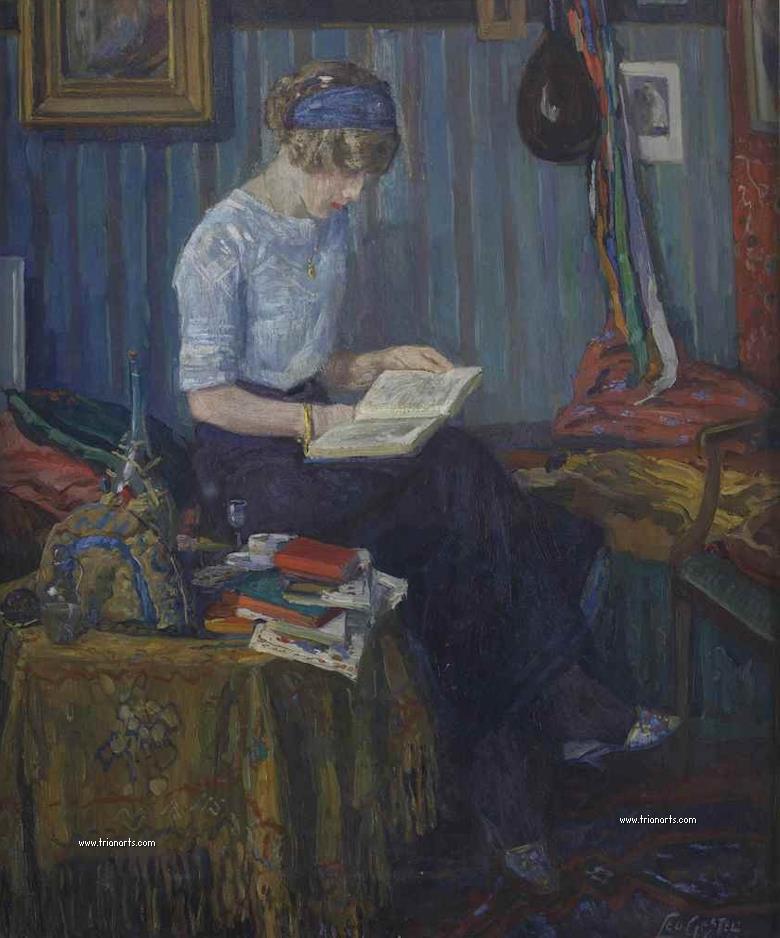
Leo Gestel (1881-1941) was a Dutch painter. This lovely work is ‘Atelierhoek’ or ‘The Studio Corner,’ winter 1910. Sold at auction in 2016 for 55,500 Euros, the original is reportedly held in a private collection. Wish it was in mine!
Described as a leading artist of Dutch modernism alongside Piet Mondrian and Jan Sluijters, Gestel’s work exemplifies the new art styles emerging in early twentieth century Europe, from cubism to expressionism to neoimpressionism. The above painting strikes me as mainly neoimpressionist, while retaining some cubist elements.
I like the reader’s contemplative pose: absorbed in her books, she has little concern for her observer.
There appears to be little scholarship on Gestel available in English, and only a few biographical details are available online. Gestel’s father Willem was reportedly also an artist. As a young man Leo was introduced to Avant-Garde artists and exhibited in Paris and Berlin. In 1914 as the First World War broke out, Gestel sketched chaotic border scenes of Belgians fleeing the widening conflict, and sold lithographs of these sketches to raise money for the Committee for Refugees. A fire in 1929 destroyed much of Gestel’s work; he died in 1941, reportedly from a longstanding stomach-related complaint.
The Cultural Heritage Agency of the Netherlands reportedly has custody of many of Gestel’s surviving sketches, notebooks and papers: fortunate are those who are able to access these materials readily!
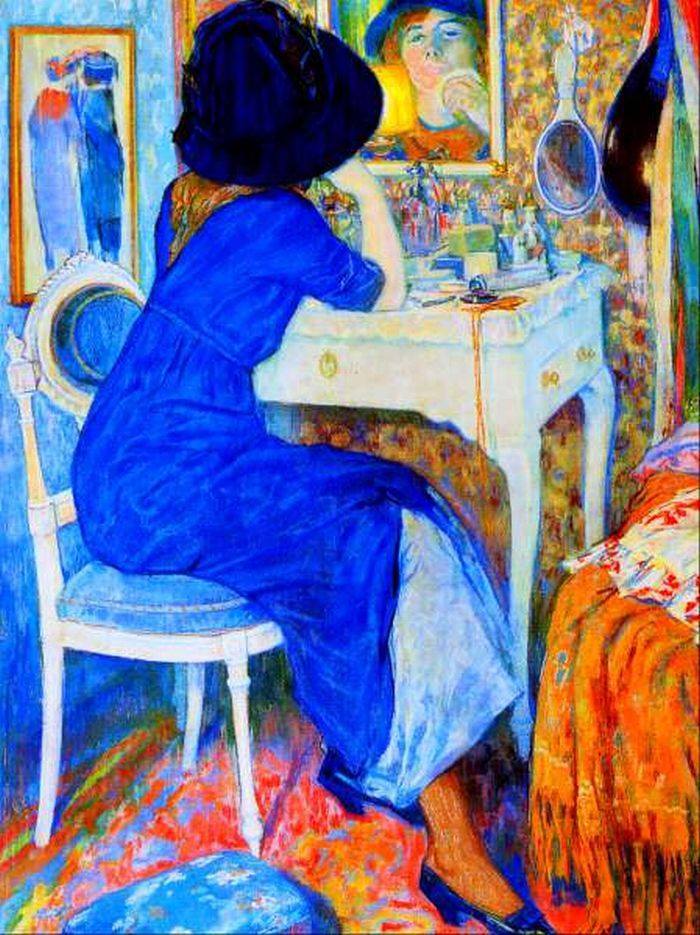
Another Gestel work I like a great deal and sometimes use as an online profile picture is ‘Lisette at Toilette’ or ‘Woman at Make-up Table, 1911, painted in a similar style although in far brighter tones. Note the image hanging on the wall, which is likely a cameo of another of Gestel’s paintings.
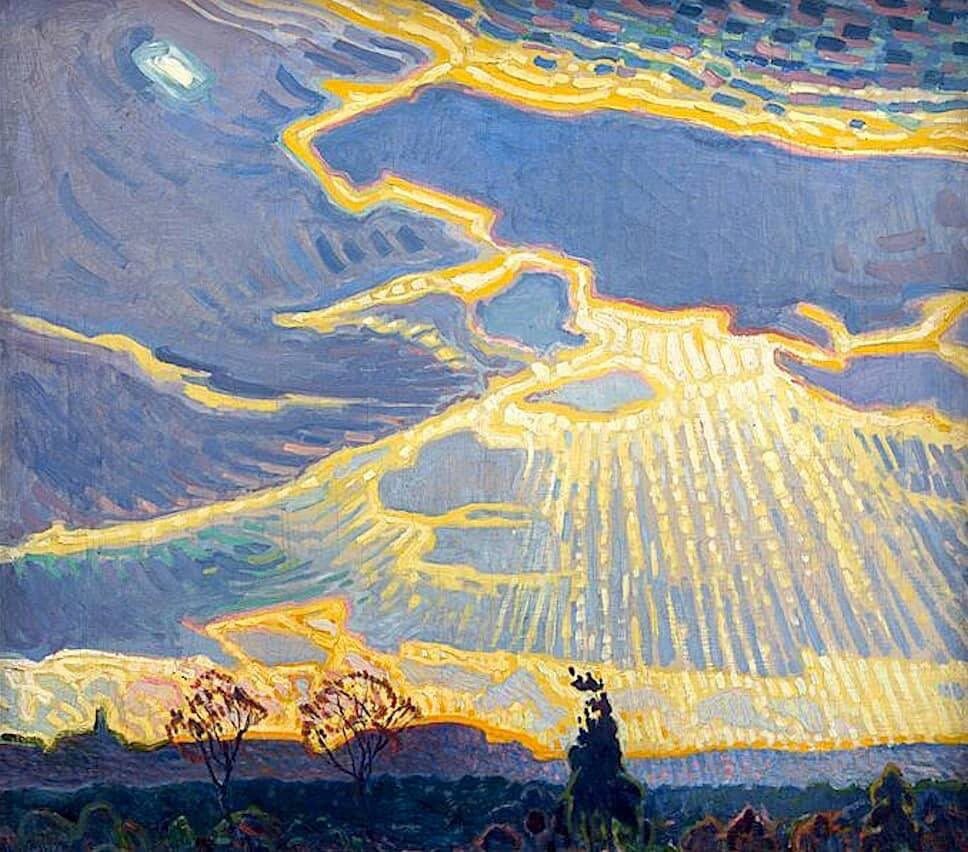
There’s also this beauty, reflecting the influence of luminism in his work. Reportedly Gestel became interested in the play of light upon landscapes. ‘Herfst’ (or ‘Autumn,’ 1909) is an excellent example of his work in this area (and cannot help but remind me, as a Canadian, of some of Lawren Harris’ work). This painting is held by the Museum Kranenburgh in Bergen, where Gestel lived and worked for a period.
Here’s Gestel himself, photographed later in life and in a youthful self-portrait (1913).


A note about this post: my initial plan was simply to share the first image, which so well evokes the contemplative mode suited to the beginning of the year. Unfortunately the quality of information available on the open internet has declined so precipitously (and in fact has been in steady decline for the last decade, as any researcher can confirm) that I had to dig quite deeply to find accurate information about the painting. The upside was that I learned more about Gestel (until today he was little more than a name), and encountered much more of his surviving work. I am sharing some of this information here as part of a commitment to ensuring decent quality information continues to be available on what remains of the open internet.
There are a number of print exhibition catalogues and/or retrospectives on Gestel’s work, available in Dutch. If you know of any material available in translation, I would be grateful to hear from you!